Showing posts with label chanoyu. Show all posts

Apr 30, 2014

NEW Class! Beginning Chado: Tray Style

The Beginning Chado: Tray Style class begins on Wednesday May 7.
.
In this class, students are introduced to the principles of making tea, including how to fold fukusa, purification of tea utensils and closing procedures.

Students will also learn good mizuya habits, as well as preparation of the tea room, and cleaning up.

There will be more emphasis on the guest role and we will cover topics such as flower arranging for tea, making sweets, kimono dressing  and other cultural studies.

It is helpful to have taken the Introduction to Chado class, but not necessary. Please bring  Fukusabasami (guest kit) and white socks to class.  If you do not have a fukusabasami, one will be provided.


Beginning Chado: Tray style
Wednesdays 7-9 pm for 10 weeks, starting May 7, 2014
Fees:  $250
Issoan Tea Room, 17761 N.W. Marylhurst Ct., Portland, OR 97229
Instructor: Margie Yap

Please reserve your place now,  with a $50 deposit,  in the left hand column.  Balance due at the first class.

If you have questions, please email Margie, or call 503-645-7058

Feb 7, 2014

Beginner's heart

One line of the kotoba reads: As we diligently learn the Way, we shall not forget the humble but eager heart of the beginner.  To many of us who have been studying the Way of tea for a number of years, it is easy to forget what it is like to be a beginner. It is easy to get jaded and consider that today, I will be doing just old hirademae.  I have done this dozens (or hundreds) of times and just go through the motions.  We forget what it is like to be a beginner.

I have a new class of beginners and they are eager and excited to come to class.  Nearly everything is new to them and somewhat intimidating. But their concentration is fierce.  They are paying attention to which foot is entering and leaving the tea room.  They are counting the number of weaves to sit in the proper place.  They listen hard when I am explaining something for the first time. They want to know the proper way to turn the bowl or which way their fan should be pointing. They are hungry for learning just about anything and everything. No matter how often I teach the beginner class, it is humbling to me that there is such enthusiasm for the Way of tea. 

When you are a beginning student, no job is beneath you.  Everything is important and you want to it properly.  Preparing your bowl to make tea is an important job.  Washing up and emptying the natsume is also an important job. For us experienced students, it is good to remember how eager we were to be included in planning a chakai, and even humble things like washing bowls, wiping tatami, and emptying the trash were important jobs.

This is why I like the gyakugatte temae.  It makes me feel like a beginner again. I have to concentrate on my footwork.  The utensils must be placed in different places and I have to remember the order and which hand goes where.  My heart beats fast, I make many mistakes, and it humbles me.  And yet, it brings back my eagerness for the Way of tea; to get it right and make the best tea I can for my guest.

Jan 15, 2014

Inayoshi Osamu, Japanese Potter coming to Portland

Thanks to the Oregon Potters Association, Inayoshi Osamu, Japanese Potter. will be presenting a demo workshop at The Oregon College of Art and Craft.Fee structure for Inayoshi Osamu workshop (demo)Download the Inayoshi flyer
 
2 days
non OPA members $75, OPA $60, students $35, OCAC students no charge

1 day
non OPA $40,. OPA $35, students $20, OCAC students no charge

Seating is limited. Cash or check payments may be made directly at the workshop. To reserve your seat in the workshop, please make checks payable to The Oregon Potter’s Association and mail to:

Joe Davis Instructor of Art, Ceramics
Mt. Hood Community College
26000 SE Stark St.., Room VA30D
Gresham, OR 97030

The workshop will take place in the ceramics lab at
The Oregon College of Art and Craft
8245 SW Barnes Rd, Portland, Oregon 97225
(503) 297-5544

Please see the .pdf for more images of Inayoshi’s work and process, and also for text and links from Hank Murrow, long-time potter in Eugene.

For more information, please contact Joe Davis (503) 491-7149 Joe.Davis@mhcc.edu

Jan 9, 2014

Hatsugama preparations

We are lucky this time of year to be able to participate in Hatsugama, the first kettle of the year.  It is one of the biggest events of the year, and I have been preparing for this since early November.   I have developed over the years a countdown checklist that starts about 2 months out from the event.  In planning, I have tried to take into consideration everything for my guests.  What they see on the day of the chakai or chaji is effortless ease, but experienced chajin know what is involved.

We are getting down to it as Hatsugama is this Saturday, and the menu and shopping for the meal is done.  As is planning the toriawase, selection of utensils.  The tea has been ordered, the house cleaned (although in my checklist, I will be cleaning at least twice more).  The cooking won’t happen until Friday evening, and Saturday morning.  Sweets will be made Friday night and a thousand of things need to be done.

I have a fellow teacher helping me this year, and have planned for her to help students dress in kimono.  The anticipation is building and I hope the guests will appreciate wha

t I have planned for them.

Dec 31, 2013

The joy of tea

Today I had the lucky opportunity of hosting a chakai for people that I had never met.  However these two people had traveled many thousands of miles from North and East of here to be my guests.   They were graduates of the Midorikai program in Kyoto and attended about 5 years before I had gone myself.

One of  my guests had not done tea for about 20 years and the other one had kept in practice even though there were few tea people to share tea where he lived. 

I started preparations earlier in the week cleaning my house top to bottom.  I cleaned, swept and vacuumed. I dusted, wiped and washed.  This morning in the quiet, I zokined the tatami and put the fresh kettle on.  As it heated, I prepared my utensils:  Unrolled the scroll and hung it carefully.  I sifted the tea and rinsed and dried the teabowl, mizusashi, and kensui. I soaked the new chakin and opened a new chasen. I arranged the utensils just outside the tea room.

Then I went to make the sweets:  White kinton with green interior.  Gomei - yukima no kusa

I cleaned the toilet, put out the tsukubai, picked and arranged the flowers.  Then I filled the natsume, arranged the sweets and went to put on my kimono. As I dressed, I thought how lucky I was to be able to host two experienced tea people who were hungry for the experience!

I went to check the kettle and it was beginning to sing.   My student came to assist, and he once more zokined the tea room,. put on his kimono and went out to wait for the guests.  He greeted them outside and assisted them inside to take off their shoes and hang up their outer garments.

Surprise, one guest wore his kimono!  Up in the tea room, the incense was lit and wafted down to greet the guests. They entered the tea room and we made them comfortable.  What a joy to make tea for these guests who appreciated everything and noticed the smallest details.  The conversation was easy and natural, the tea was made and drank.   They even had two bowls of tea each.

After everyone got feeling back in their feet we sat just outside the tea room and visited, but like very good guests, they didn't stay long because they knew we had things to do.

My student and I had a bowl of tea  and then cleaned up, closed the tea room and said goodbye. It was a very satisfying and fulfilling experience.   This is why we study the way of tea.


Jan 19, 2013

Shogatsu 2013

The Portland Japanese Garden Shogatsu celebration, where we made tea for the public with the Misonodana.


Dec 28, 2012

Winter intensive

The day after Christmas, December 26th we had our first Winter intensive at Issoan Tea School.  For my students it was their first intensive.  We started at 3 pm and ended at 9:30 pm.  In between we sat zazen, practiced warigeiko, reviewed movement in the tearoom,  did five teamae, laid the charcoal shozumi and rebuilt the charcoal fire gozumi.  One student brought a sushi platter and I made ankake udon for everyone.  It was such a success, that we plan to make it an annual event.

Shozumi and Gozumi, laying the initial fire and reubuilding the fire were particular highlights.  We don't often get to do these procedures, and especially gozumi so it was a special treat.  The charcoal is kind of like your timing device to keep your tea gathering on track. The charcoal is made from special wood and cut into specific size and shape to burn for a specified length of time.   It is amazing to hear the singing of the kettle suddenly go silent (and it does seem to be sudden) all at once.  It is also a clue to the guests that it is time to take their leave.

Of the two, gozumi is more difficult because you never know what the fire is going to look like as it burns down.  Many factors contribute to how the fire burns, from the haigata (ash form), to how the initial fire was laid, to shape of the kettle, how big the furo, how deep the ro,  to how long the fire has burned. 

So as a host, the first thing you do when you remove the kettle replenish it is to observe how the fire has burned.  How much charcoal is left?  Did the center collapse?  How much of the dozumi (large front charcoal) has burned?  Then you rearrange the coals to make room for fresh charcoal and lay them in the fire.  You have to use your own judgement whether to use all the charcoal in the basket or only use part of them.

It was a nice fire the students built.  And within 30 seconds of returning the kettle to the fire, we once again heard the matsukaze, the sound of the wind in the pines and the murmuring of the kettle.

Oct 30, 2012

Wagashi basics, shiro an

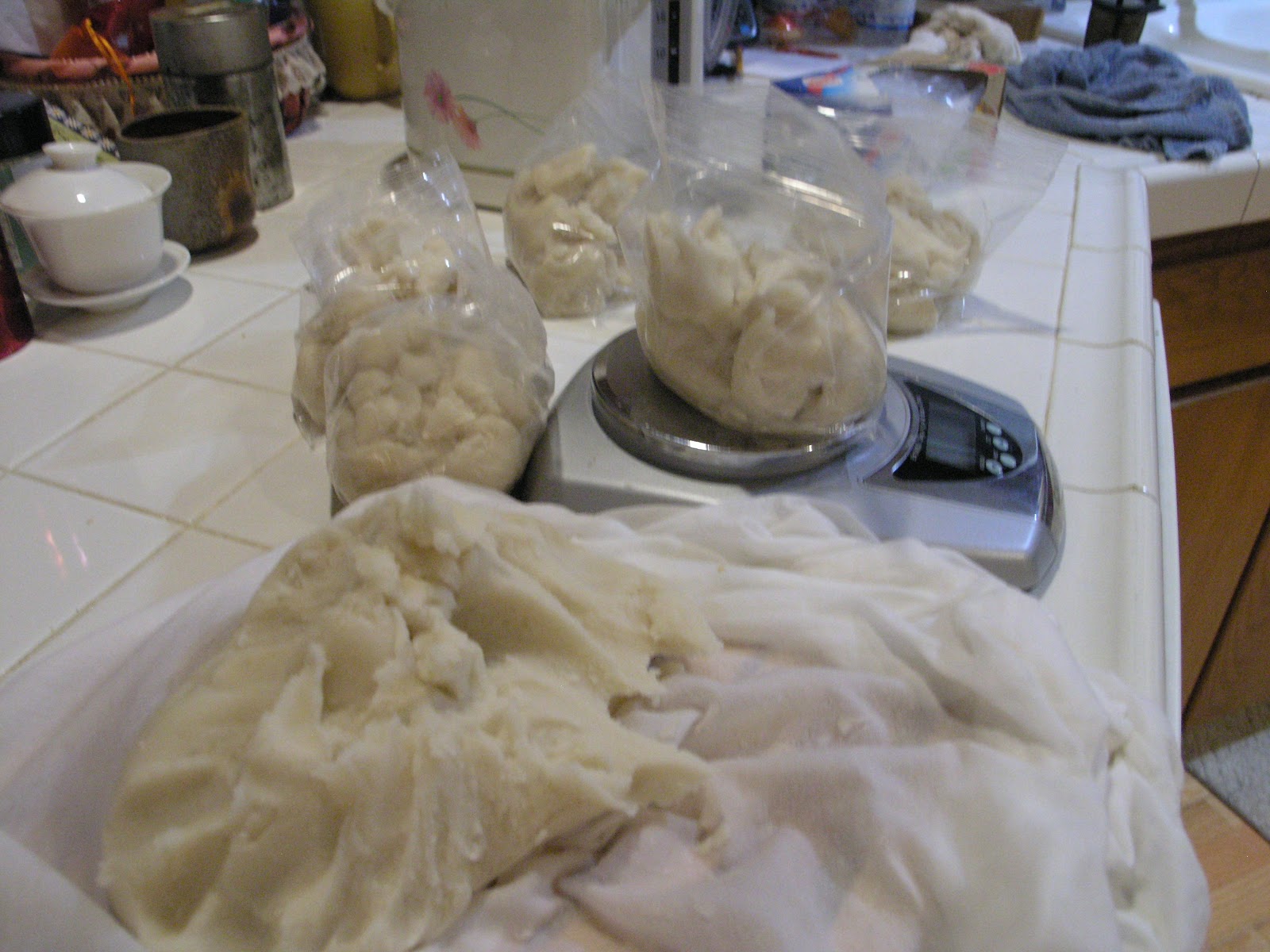
Shiro an is a basic ingredient for making wagashi, or Japanese tea sweets.  This white bean paste can be colored, hand formed, molded and manipulated and used in many. many different ways to make different kinds of wagashi.

When I was learning to make this, Minako sensei said to make a big batch, because it takes too much work to make just a little bit.  You can divide up the bean paste into smaller, usable batches and  freeze them in individual bags, then thaw just a smaller amount for what you need.  It took me all day to make this batch.

Good bean paste starts with good beans.  I use organic lima beans.  You can use any kind of white beans to start.  Sort and discard any broken, misshapen or discolored beans.  Put them in a large pot or bowl and cover with cold water and soak them overnight.

The next day, when the beans have softened, take the skins off.  I also remove the little nub or sprout because it makes for smoother bean paste.  You can certainly compost the bean skins, or put them in the blender and use them for filler for bread, meatloaf etc.

After you have removed all the skins, put them in a pot and cover with cold water and bring to a simmer over medium heat


As the beans come to a boil, skim off the foam that comes to the top.  When the water comes to a simmer (not full boil), change the water by dipping it out with a plastic container and replacing it with fresh cold water.  Do this 3-4 times or until the water is no longer discolored.  Bring to a simmer, dip out the hot water, replace with cold water.


Continue to simmer until the beans fall apart.  This may take longer than you think it will.


I then pour the bean slush into the blender and pulse it a couple of  times to make sure all the beans are broken up and smooth.  You can also use a food mill, sieve or food processor.


Pour the slush back into the pot or a large bowl and let the bean paste settle. 


You will see the two layers begin to separate after about 10 minutes. Pour off the top layer of discolored liquid, and refill the pot with fresh cold water.


Let the mixture settle and pour off the top layer.  Do this many times.  How many?  Until the top layer becomes clear.  Sometimes I have done it as many as 10 times.  The paste settles faster as the toip layer is poured off with lighter material.  When the top layer is clear, put a muslin jelly bag over a strainer in the sink, (or I just use a clean flour sack towel).  Pour the bean mixture into the bag, drain and then squeeze out or wring as much water as you can.  The more water you can squeeze out, the less time the next step will take. The pste should be dry. Good, now you have unsweetened bean paste called nama an and we are half-way done.

Weigh out the bean paste and return to the pot (without the jelly bag or flour sack towel).

I don't like my sweets too sweet, so I use one third of the weight of the bean paste and measure that amount of sugar.  Put all of the sugar and half of the bean paste in the pot and heat over medium-low  heat stirring constantly.  As the sugar melts, the mixture will get very thin.

When the mixture begins to boil, add the rest of the bean paste.  Keep cooking over medium heat, stirring constantly to prevent sticking and burning.  It will begin to thicken


Cook over medium heat until the mixture mounds nicely and is not sticky to the touch.  It looks like mashed potatoes. 


The moisture content will var accoring to the ultimate use.  Dryer for molding, stickier for kinton.

Remove from the heat and distribute in small mounds to a well-wrung, damp, lint-free dish towel and cover to cool.

This white bean paste can be frozen for up to 3 months if double wrapped and sealed tightly.

When I thaw the bean paste, I put it in the microwave to thaw and warm it.  To make it pliable and easier to work with, knead in a damp dish towel.  You can then color it, form it, add other ingredients and use with other ingredients to make you favorite wagashi.


Oct 9, 2012

Conference on Chanoyu


お茶三昧 Ocha Zanmai:
 The 2012 San Francisco International Conference on Chanoyu and Tea Cultures
Saturday, November 10, 2012
Co-sponsored by San Francisco State University and the University of San Francisco
in partnership with
The Dilena Takeyama Center for the Study of Japan and Japanese Cultures
Open to the Public
 (18 years of age and above)
9:00-17:30  Keynote Lectures, Presentations, and a Korean Tea Ceremony
San Francisco State University
18:15-21:00 Reception and Banquet
University of San Francisco

This academic conference, which will be held under the joint sponsorship of two universities in the city of San Francisco and the Dilena Takeyama Center for the Study of Japan and Japanese Culture, will be the first ever event of its kind on chanoyu (Japanese tea ceremony) and tea culture on the West Coast of the United States.  The research presentations and a special Korean tea ceremony will take place during the morning and afternoon of November 10 at San Francisco State University, in the southwestern corner of the city.  Following the conclusion of this program, the University of San Francisco, a private Jesuit university located just north of Golden Gate Park, will host an evening reception and dinner banquet for conference attendees. 

Two renowned specialists have been invited to give keynote lectures: Dr. Asao Kōzu, widely known for his expertise in the history of tea, and Dr. Tamaki Yano, who has gained universal recognition for his research on Kundaikansouchōki, a text dating from the Muromachi period.  Speaking in Japanese, Dr. Kōzu will present a new perspective on the wabi-cha of Sen no Rikyū, while Dr. Yano will deliver his lecture on the records of famous tea objects in English.  Additional presentations by researchers from Japan and the U.S. will treat topics such as calligraphy scrolls, flower arrangement, bamboo baskets, and various aspects of tea ritual. 

The entire program from morning to evening will be open to the general public.  We strongly encourage anyone with an interest in the topic to attend; you need not be affiliated with a tea school or to have ever participated in a tea ceremony.  Please note that we will limit attendees to ages 18 and above.  We have set aside a Q & A session after each presentation, when speakers and experts will entertain questions and comments from the audience.

To encourage the greatest possible number of attendees, we have set the admission fee at very reasonable $10 ($5 for students) for those who pre-register by October 17, and $20 ($10 students) for on-site registrations. We firmly believe that chanoyu’s spirit of sincerity extending between host and guest can transcend borders and contribute to harmony among people all around the world, thereby promoting world peace.  We look forward to seeing you there!

Midori McKeon                                     Stephen John Roddy                     Jon Funabiki                 
Conference Chair and Organizer        Conference Coordinator                Conference Partner
San Francisco State University           University of San Francisco          Dilena Takeyama Center for the
                                                                                                                              Study
of Japan and Japanese Culture           

For further information, please contact mmckeon@... or 415-338-1346.    

Sep 24, 2012

Confessions of a Chado geek

It has been more than a week since we had an intensive workshop here in Portland with Machida Gyotei sensei and we are grateful to Urasenke and Oiemoto for sending him to Portland.   I don't remember the last time we had a Gyotei sensei in Portland, but I have studied with them while I was in Kyoto, Japan and Seattle.

It always takes me awhile to process what was presented because it is like drinking from a firehose, there is so much information presented in such a short time.

As always we start the seminar with warigeiko, back to basics of folding the fukusa.  Though each time we do it, I learn something new.  Machida Gyotei sensei teaches in a little different manner than others I have studied with.   He asks questions designed to make you think deeply about what you are doing.  For example, he asked us the first day, "Why to you fold the fukusa in this manner to purify utensils?   Did you know that the fukusa is not exactly square?  Why to you think that is?

We studied from the very basic usucha procedures to the most advanced daisu  procedures in the course of three very full days.   On the third day in the afternoon, we practiced kagetsu, including two that I have not done before ko-tsuki kagetsu, and yojohan kagetsu (kagetsu in the four and a half mat room).

Machida Gyotei-sensei  offered practical advice in his lecture, Movement within the tea room, and got into some very philosophical aspects of Buddhist and Chinese daisu procedures, how to handle precious utensils and things to think about for later.  All with a charming and funny demeanor.

It was overwhelming and inspirational at at the same time.   And yes, I really needed that hot tub after sitting on my knees for three days.

Sep 17, 2012

Fall Introduction to Chado Class

The Fall Beginners Class: Introduction to Chado, The Japanese Tea Ceremony is now forming.

Students will learn the etiquette of how to be a guest at a tea ceremony, the basic order of the tea ceremony and how to whisk green powdered ceremonial tea. Students will also participate in Japanese tea ceremonies.  An overview of Japanese aesthetics and how tea has influenced Japanese culture will be presented.  Students will also be introduced to tea ceramics, calligraphy, kimono dressing, and incense ceremony. They will also be introduced to zazen meditation and discuss how to put tea practice into every day life.

Meets, Thursdays 6-8:30, for 10 weeks starting October 4, 2012
Fee: $250, includes all equipment, tea, sweets and supplies for all classes including calligraphy, kimono and incense.

We have a new SE Portland venue:

Portland Tea Enthusiasts' Alliance
828 Southeast Ash Street, #204
Portland, OR 97214
To register contact
Marjorie Yap, Instructor
Phone: 503.645.7058,
margie@issoantea.com
website www.issoantea.com

Alternate contact while I am out of town

(971) 258-2832


Aug 31, 2012

Chado: The Way of Tea in Oregon

Tim McRobert produced a half hour documentary about Chado: The Way of Tea in Oregon. It will be broadcast on Oregon Public Broadcasting cable this Sunday. It was shot at the Portland Japanese Garden and various tea rooms around the Portland area.

Issoan Tea School is one of the groups featured in the film.You will see students making tea, kimono dressing and ceramics discussion on the film. I hope you enjoy it.

It airs Sunday, September 2 at 8:30 on OPB plus.  For those of you on FIOS Frontier it's channel 470 and those on Comcast I think  it is on 310.  Check your local listings. 

Aug 11, 2012

The ash is important to the charcoal

This summer we have been fortunate to be able to burn charcoal and do sumidemae.  We can't make tea if the charcoal doesn't boil the water.  For some reason, the water boiled with charcoal tastes better, sounds better and the steam is more consistently fluffy and pretty.

Of course, it all begins with the haigata or ash form. The first time I saw the ash form, I thought it was some kind of cardboard, and I stuck my finger in the front of it and spoiled the look of it. Making the haigata takes patience and practice. 

When I was at Midorikai we got to burn sumi everyday, and that means one of the chores after dinner was to do the haigata for the next day.  Fortunately for me, I like to do it, and my fellow students didn't, so I did many ash forms during the furo season as I could.  When we switched to the ro season, I bought a furo, ash, gotoku and practiced  in my room just about every night.

I think we got one lesson on ash forms and the rest of the year we were left to discover for ourselves how to do it by practice and experience. Sometimes one of the teachers would come up to the mizuya after dinner and drop the haisaji (ash spooon) in the middle of the haigata.   If the spoon stood upright in the ash, it was too hard packed and the fire couldn't breathe.  If the spoon fell over in the ash, it was soft enough for the fire to burn.  Of course, either way, you had to do it over again.

A few things I learned about doing haigata: 
  1. Don't spend more than 45 minutes playing with the ash.  The more you work it, the more it gets packed down.  Torigai-sensei used to say, "Better an ugly haigata that breathes, than a beautiful one that is too packed down."
  2. There are three main tools to form the ash. The wide flat tool, the curved tool and the spear point tool. I use the wide flat tool for maybe 75-80%  of the time.
  3. Let the ash tool do most of the work.  You really are not pushing down on the ash spoon to smooth it out.  Just lay the tool down gently on the ash and drag it across the surface of the ash.  You will get a beautiful smooth surface without it getting too packed down.
  4. I usually start smoothing the front, then the back then the U shaped valley in the center.  Make sure the valley is deep enough to accommodate the height of the charcoal, plus the width of the kudazumi and edazumi so it won't get crushed when you put the kettle on the gotoku.
  5. Sometimes the angle of what you want to do is very awkward.  Learn to use your left hand to work the right side of the form.   You may have to re-grip the tool in  a different place to get the angle you want.
  6. The only place that is okay to pack down the ash is right behind the maegawara (front tile).  This helps hold the mae gawara in place.
  7. Pay special attention to the corners and the points of the mountains.   It takes practice to make these smooth and sharp.
  8. Smoothing and cutting around the gotoku and maegawara are the trickiest.  The mountain in the front should look like there is no interruption in the line and it looks like it goes right through the gotoku.

If you get a chance to work the ash, it becomes very meditative and sometimes addicting.  Relax and it will show in the final product.  Good luck.


Jul 18, 2012

Presentation at the Portland Japanese Garden

Issoan Tea School will be presenting Chado, the Way of  Tea at the Portland Japanese Garden this Saturday, July 21st at 1 and 2 pm.

Please join us for a presentation of the Tea Ceremony at Kashintei, the "Flower heart arbor" tea house at the Portland Japanese Garden.  The presentat6ion is free with admission to the garden.

Chado 茶道, the Way of Tea, is the practice of preparing, serving, and drinking Tea. Since the 15th century, it has been a study in preparing a bowl of powdered green tea (matcha 抹茶) as well as incorporating many of the arts of Japan. This elegant yet simple practice reflects the philosophy of the four principles of Tea:

Harmony: Wa
Respect: Kei
Purity: Sei
Tranquility: Jaku

Where: Portland Japanese Garden, 611 SW Kingston Ave, Portland, Oregon 97205
When:  Saturday, July 21, 2012 at 1 and 2 pm
For more information: Chado the way of Tea, (503) 223-1321

Jul 16, 2012

Tanabata Chakai

A wonderful day of tea Saturday at the Issoan Tea School.  Students celebrated the Star Festival with a chakai put on the advanced class who invited the new students who had never attended a chakai before.

We went through the planning process from choosing a theme, utensils, poetic names, hand made invitations to making sweets.

Students arrived at the school very early to clean everything, top to bottom tea room, mizuya, machiai and walkway outside.

They washed and dried all the utensils and trays and bowls for the light meal.  We cooked the food and arranged the trays.


The tea room and mizuya were then set up and we rehearsed the order of the gathering.

Then everyone changed into kimono and the guests began to arrive.  Even though it was a lot of work, I think everyone had a good time.

Thank you guests and thank you hosts for a wonderful tea day.

Jun 30, 2012

New reading material

I just want to call your attention to a few new (at least new to me) publications of interest to fellow Chado students, and they are in English.  You can find these along with other recommended books at the Issoan Tea Site.

NEW! Sen Genshitsu Talks About the Enjoyment Of Tea by Sen Genshitsu, Urasenke Grand Tea Master XV, Translated to English by Maya Perry
ISBN-10: 4473032965 Paperback
ISBN-13: 978-4473032966

Fifteenth Generation Urassenke Grand Master talks about memorable tea gatherings, guest and host, the lineage of Rikyu, the spirit of hospitality, tea equipment, and becoming better at doing tea among many other topics.  Notable for the English translation of the hundred poems at the back of the book.


NEW! Urasenke Chado Textbook, translated to English based on the Japanese textbook, Urasenke Chado
ISBN-10: 4473036960 Paperback
ISBN-13: 978-4473036964

Replacement for Uransenke Handbooks 1 and 2.  A much more informational book with less emphasis on actual teaching and photos of procedures.  Topics include:  the spirit of Chado, Zen, Classics related to Chado, tea and health, history and development of Chado, the tea room, the roji, utensils and the significance of temae. Reference material at the back of the book.


NEW! Moon by the Window, The Calligraphy and Zen Insights of Shodo Harada
ISBN 9780861716487 Paperback

Shodo Harada is internationally recognized both as a Zen teacher and as a world class master of the fine art of Zen calligraphy.  Harada regularly exhibits and gives calligraphy demonstrations in museums and universities in the U.S. and abroad.  Moon by the Window is a collection of 108 pieces of Shodo Harada's calligraphic Zen masterpieces assembled over the decades, and drawn from the rich and poetic literature of the Zen tradition.  Each work is accompanied by Harada Roshi's sharp and glittering commentaries, making each page a spiritually edifying and aesthetically uplifting  treasure.

Jun 27, 2012

Meibutsugire part 4 Kanto

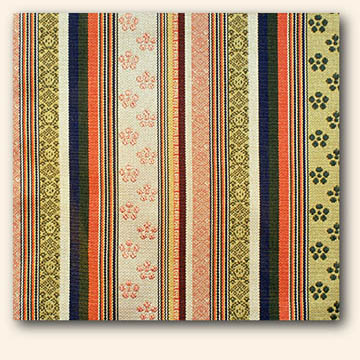
Fabrics with stripes, plaid or checked patterns are called kanto. There are different reasons why fabrics with certain patterns can be considered kanto fabrics, and no clear rules exist for classifying them.

In the 16th centry, when kanto fabrics were introduced into Japan, the striped and checked patterns felt new and fresh to chajin (Tea practitioners). From that time on, they were used for making pouches for chaire (thick tea container), considerably earlier than donsu and kinran. Even after donsu and kinran became highly valued, the use of kanto fabrics did not decline because they provided a new range of fabric colors.

Here are a few examples:

Aoki kanto
 The name of this fabric comes from its original owner, Aoki, who was Toyotomi Hideyoshi shogun's retainer.

Kapitan kanto

Kapitan kanto with large stripes

Mumei kanto
Sushuji kanto
Tosai Kanto (10 colors)


Nikuzushi kanto
Nikuzushi kanto close up


All three above: Sagara kanto

Yoshino kanto
 It is said that Lady Yoshino favoured this pattern for her Uchikake, a coat dress. She was a wife of Haiya Jyoeki, a rich merchant who lived in Kyoto in 17th century.
Yoshino kanto
My sensei had a beloved bunrin chaire with a shifuku made of this kereji in these exact colors.  We used it for many years until she passed away.  We don't know what happened to the chaire, but it remains one of my favorite fabrics.


*Fabric photos courtesy of  Kitamura Tokusai Fukusaten Co., Ltd., Kyoto, Japan.via the now closed website Tea Hyakka..