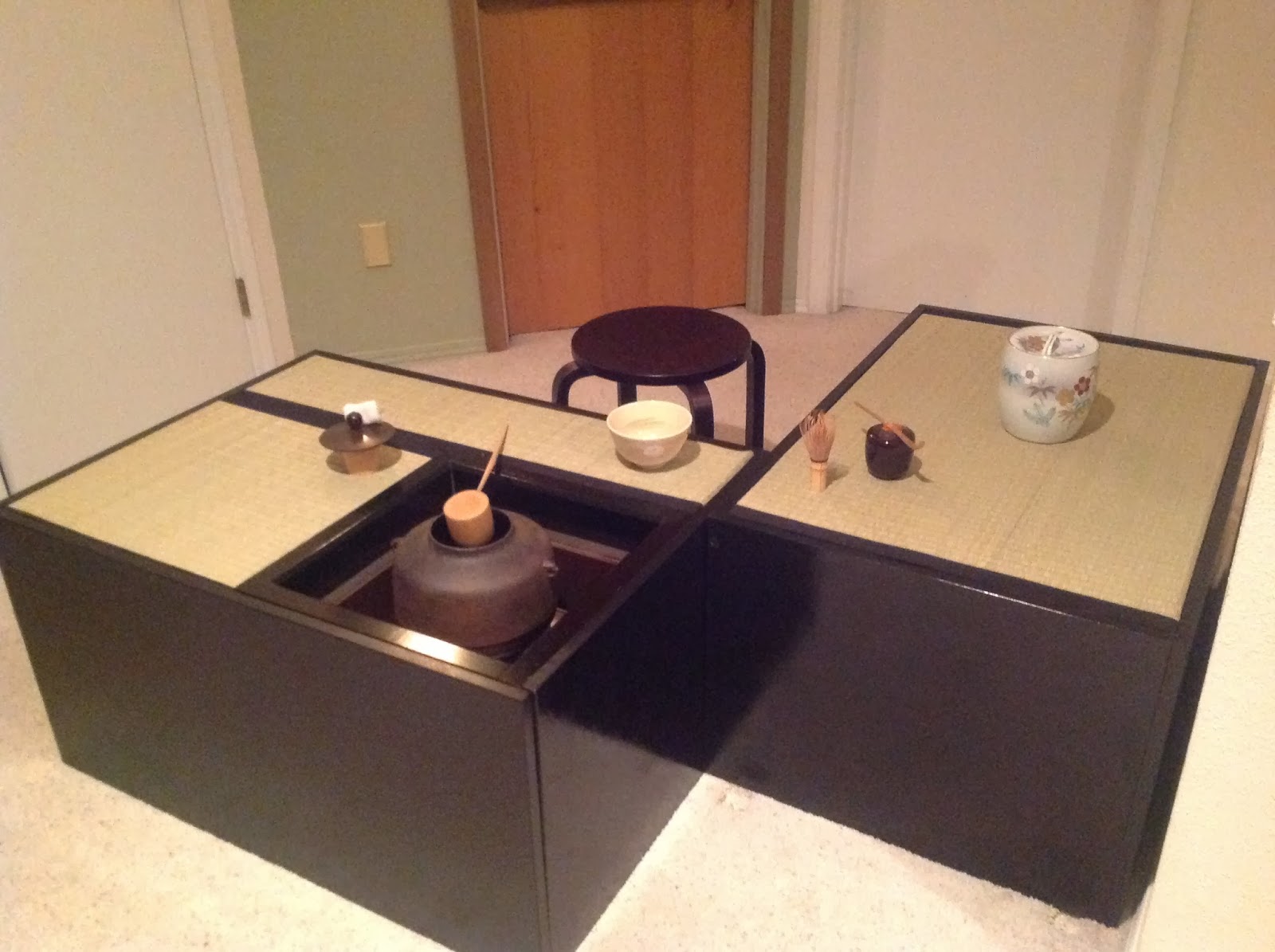
I have a few students who can no longer sit seiza on tatami. Some of them are sad because there are only a few table style temae you can do. And there is no difference in the seasons for table style. So I had a plan for them.
In Portland, we have been rather snowed in for the last three days. That means that Mr. Sweetpersimmon has been in the shop and I have been at the sewing machine. Look what we completed this week. I asked my husband to build me a tatami table so that my students who cannot kneel can sit and make tea on stools. From photos and diagrams he designed and built not only a tatami table, but a table that can fit a sunken ro. He also designed the two tables to be portable. They fold up into two boxes. Not only that, he made the right hand table so that it can be changed out for the furo season. This means that we can do any temae on this table. Which is good, because he will soon close the tea room for phase 2 of the renovations, and we can still have class on the tatami table.
Feb 9, 2014
Elevate your temae
Dec 2, 2013
Seiza seats now on sale at Sweetpersimmon.com
Made from sustainable wood and eco-friendly milk paint, our Portable Meditation Seat weighs just 12 oz. and comes in its own carry bag that doubles as padding. It's small enough to fit in a purse, briefcase or gym bag. Great for travel, meditation retreats or even used as a backpacking camp stool where every ounce counts. The unique design and finish of our Portable Meditation Seat reflect the Japanese wabi aesthetic of rustic, simple beauty.
Size: 8 by 5.5 by 4 inches in carrying case
Dimensions: 7.5" wide by 4" deep by 7.75" tall when assembled
Weight: 1 lb. 4 ounces
Just for you, my readers, here is the coupon code for free shipping: FREE SHIP
And while you are there, look around at the new handbags I just listed.
"I like my new zazen bench. It's Great! ...everyone thought it was extremely cool. I could hardly believe it could be small enough to put in your kimono sleeve, but it sure enough is! The design is just so clean and functional, it's so nicely finished and so strong, and I love how the bag converts to upholstery. It really fits a guy my size perfectly." ~ Tim Sowa Olson, Tea Ceremony Sensei, Seattle Urasenke Branch
May 6, 2008
New tea stuff
SweetPersimmon.com now has beginning matcha sets. Tea bowl, whisk and tea scoop with a can of powdered tea and you can now make a good bowl of matcha
There are also new tea bowls, Japanese green tea kyusu (side handled tea pots) and iron tetsubin.
Also for those of you who need a taller meditation seat for seiza sitting or zazen, I have developed a new taller model. Same high quality, portability, simple design with its own carry case. You can choose from 5 colors or unfinished.
Stay tuned for more developments at the site.
Don't forget, the new beginner's class at Issoan will be starting May 19th.
Apr 26, 2008
The Physicality of Tea Practice
For those who study martial arts or are involved in sports, tea practice looks like it is sedentary, not a physical activity. After all, it is done sitting on tatami and it is quiet and calm. But there is a physicality to tea practice that is sometimes much more difficult than that of moving your body vigorously.
Tea practice is about control. To be able to move slowly, precisely and gracefully takes long practice. To be able to make it look effortless and easy takes even more practice. To know where your body will end up when you sit down takes practice. To put utensils down in the proper place (a centimeter off is in the wrong place), takes experience to know where in relation to your body it should go.
Most excruciating of all is being able to make tea and drink tea while sitting in seiza. Being uncomfortable and still be able to do what you need to do with your whole attention and awareness is mostly mental. But physical endurance is also important. It takes training to work up to sitting for hours on tatami in seiza, but if you sit for a little bit each day and gradually increase your time sitting, your body will adjust. The thing is to stick with it long enough to build up your endurance.
It is funny when sensei tells tea students that it is time to take a break, so everyone should stand up to rest. Only in the tea room.
Apr 7, 2008
Moving in kimono
Part of the beauty of chanoyu is the stately and graceful way that the host moves in and out of the room and the sound of silk on tatami mats. I am so glad that my students want to wear kimono to okeiko. As part of the introduction to tea ceremony, I dress my students in kimono so that they know what it feels like.
It is amazing how much the kimono affects our movements within the tea room. When I was first learning tea, I felt like a cow in the tea room. I had such a hard time moving around in the tea room and feeling like I had any kind of control of my body. Then when my sensei dressed me in kimono I felt even more restricted and awkward. Just sitting down and standing up became a challenge. I could not judge where I would land and I always made a loud thunk as my knees would hit the tatami. Then I would have to squirm back and forth or side to side to move to the right place and the kimono would come apart at the knees and it would take me forever to fix and adjust it.
I thought I knew how to walk, but in the beginning I would take too large a stride or walk too fast and my kimono would tangle in my legs. In the tea room, we take two steps per half tatami mat and if you walk properly in kimono, your stride comes out to just the right size and you end up entering and exiting on the correct foot. Women’s obi do not allow slouching so it forces you to sit with correct posture and when you sit with correct posture, seiza sitting is not as painful (though seiza sitting is still hurts, just not as much). If you sit with the correct posture, you also won’t have to keep adjusting your collar because of gaps that come with slouches.
I also found in dealing with the sleeves of the kimono, I was much more conscious of my arm position, wrist position and keeping my elbows round. That is not to say that I still drag my sleeve through the kensui on occasion.
After okeiko, I would always wear my kimono home. Partly because I feel very special wearing kimono, and partly because my husband says that all women in kimono are beautiful.
Mar 22, 2008
Observing vs. doing
Observing is much harder than doing in tea. Perhaps in life as well. When I began to study tea making procedures, I was very excited to make tea. But when it came my turn to be a guest or just an observer, I let my focus wander. When the teacher was correcting another student at some point in the procedure, I really didn’t pay attention. Inevitably, when it was my turn to make tea, I made exactly the same mistake at exactly the same point in the procedure.
A note one of my students made to me last month was that sitting seiza was much easier when making tea than being the guest, and hardest of all was to sit in seiza through the whole temae as an observer. By having something to occupy our minds and hands, it takes the focus off of the pain in the feet and legs.
Chanoyu cannot be learned from a book or video. While you can learn many things from observing and watching, one must experience chanoyu and participate fully with all of your senses for both the host and the guest roles.
In this regard, I often compare chanoyu with learning to ride a bicycle. We could listen to experts talk about the physics of balance and have experienced bicycle riders relate stories of great rides they went on. We could even have an instructional video of learning to ride a bicycle with step-by-step procedures. And yet, until one actually gets on a bicycle and learns what it feels like to balance, pump the pedals and lean into a turn, you really have not learned to ride a bicycle.
Mar 4, 2008
Order from chaos
When we first begin to learn chanoyu, it seems like all we can manage is to remember the order of things, and getting control of our bodies in the tea room. All of our energy is drawn inwards as we exercise the self-discipline of temae. We face the challenge of endurance as we build up our tolerance for sitting seiza for longer and longer periods of time without excruciating pain. Our focus and concentration improves and the movements become more familiar.
One day it just happens. Order comes from the chaos inside our brain. Something clicks and we are here in the tea room with a guest. Yes, we are making tea for our guest, but now there is a live person in the room with us. When this happens, the tea room changes. Our guest is breathing with us, he is participating in the ritual. Through mutual consideration, host and guest create a new experience for each other. Unspoken communication occurs and small nuances in the ritual take on new meanings. Though host and guest have their roles to play, the give and take of such an experience can be quite moving.
This, for me is the magic of chanoyu. This is why chanoyu cannot be done alone. This is why one cannot learn chanoyu from a book, or from the video “Tea mastership in a day.” Each experience of the ceremony is unique and special. All the training, all the preparation and all the years of work make it worthwhile.
Nov 12, 2007
Sitting seiza is not comfortable
One of the most difficult things about chado is sitting seiza for long periods of time. I have written about my struggles with sitting on my knees and suffering with the cramps, the pain and the numbness that comes from sitting seiza. Often, it is the moving after sitting that is more painful as the circulation brings back the familiar sensation of needles to the feet and ankles. One must be very careful getting up after sitting if the feet are completely numb. It is dangerous and I have seen people break ankles and not know it because there was absolutely no feeling in the legs below the knee from sitting seiza. As I am getting older, too, the stiffness is getting worse in my joints and I cannot move as easily as I could when I was younger.
I tell my students that want to sit for longer periods of time, that one must sit every day. Even if it is just for a few minutes watching TV, working up to longer and longer periods of time. There are also subtle ways of wiggling toes and ankles to keep the circulation going so that they don't fall asleep. Correct posture helps, and also it has become a little easier as I have lost 10-15 pounds recently. There are also sitting stools, seats, cushions and benches that take the pressure off the ankles and allow sitting for longer periods.
I remember how one of my sensei told a student to practice sitting seiza in the bath tub. He tried it and found it extremely painful to sit on the porcelain of the tub. He just figured that by comparison, sitting on tatami was softer than porcelain. When he told her that now he was grateful for the suggestion to sit in the tub, because now sitting on tatami, though still uncomfortable for him, it was better than on the cold porcelain of the bathtub. She had forgot to tell him to fill the tub with hot water. That it would loosen his muscles and joints, and the water would buoy up some of his weight.
I sit seiza when I do zazen, or sitting meditation, rather than in the cross legged or half lotus position. First of all you cannot sit in cross legged position in kimono, and I can now sit for longer periods of time in seiza than I can in most other positions.
The point of all this? I think that training my body to sit seiza is training to endure being uncomfortable. I am so addicted to comfort that most of the time I will go out of my way or do most anything to avoid being uncomfortable. Sitting seiza is a reminder to me that being uncomfortable is not fatal to my existence, and may even bring about some kind of realization. By avoiding discomfort, what kind of decisions am I making that I also avoid experiencing life to the fullest? I find that I can be uncomfortable and still be aware and present to what is going on around me. I find that I can still be uncomfortable and still carry on with what I am doing. That I can no longer use discomfort as an excuse not to do something that needs to be done.
You can get my specially designed portable meditation seat to help you sit seiza for longer periods of time at www.SweetPersimmon.com.
Aug 17, 2007
Sitting Seiza in Comfort


I just got an email from a person who ordered a Portable Meditation Seat from my online store:
I suppose it wasn't the best planning in the world to take a six-hour hike up and around Tiger Mountain the day before my tea class. My teacher could clearly see that I was hurting as my 60-plus year-old knees winced in pain as the class wore on.
At a break in the lesson he handed me a small package wrapped in an attractive green cloth. Opening it I found pain relief in the shape of three pieces of wood, one of Sweet Persimmon's seiza stools.
I'd purchased a similar stool years ago in Japan but it never gave me any relief. Its dimensions were wrong for my Western frame but the Sweet Persimmon one was perfect! It took me five seconds to assemble the seat and another five to tie the padded fabric to it and thus give me some extra (and welcome) padding.
The rest of the class was a joy as I was able to give my full attention to my instructor. And, because the way the stool is built, you would have to look hard to realize I wasn't sitting in full seiza position.
Needless to say, that night I ordered my own! It's been great to have in class and, even though I have a class tomorrow, I think I'll tackle Mt. Catherine today . . .
A grateful tea student
You can order your Portable Meditation seat from SweetPersimmon.com and sit in comfort, too.
Aug 16, 2007
I go to keiko every week
I really don’t go to tea lessons or tea class at least I don’t call it that. It just seems inadequate to what I am doing. When people ask where I go every week after work, I tell them I am going keiko. Keiko in Japanese means training or practice or to learn or involve oneself. The next thing that they ask is after 25 years what are you training or practicing for?
Going to keiko is not necessarily practice for doing a chaji (tea gathering) nor is it necessarily for advancing to the next certificate level nor for keeping in shape, though there is nothing like training your legs for sitting seiza through a 4 hour chaji. Going every week to keiko isn’t really to get to some end result, complete a study, or train for a big event.
Even if I go to keiko and just clean the tatami or wash and put utensils away, it is still as meaningful as if I went through the whole ritual of preparing and serving tea. There is just something so satisfying about going to keiko. No matter how hard it is to get myself to class, to prepare for tea, to go through the hassle of putting on layer after layer of kimono, every week I come away exhausted but nourished. It feeds and fills some place in me that makes it worth while. I feel inspired and energized and ready to face the week ahead.
Jul 31, 2007
Sitting seiza, the bane of tea students
Studying traditional chanoyu takes place in a tatami mat room. The proper way to sit is seiza. To sit in seiza, first kneel on the floor, and then rest the buttocks on your heels, with the tops of the feet flat on the floor. The hands are sometimes folded modestly in the lap and sometimes placed palm down on the upper thighs with the fingers close together. The back is kept straight, though not unnaturally stiff. Traditionally, women sit with the knees one fist width apart, while men sit with two fist widths of distance between the knees. The big toes may rest side by side or are sometimes overlapped. Some martial arts, notably kendo and iaido also use seiza position and also can be used for sitting meditation or zazen.
While practice, exercises and experience make it more comfortable to move around in the Tea room sitting seiza, for long periods of time, can be quite painful or your feet fall completely asleep and become dead weights making it difficult and dangerous to get up and walk.
At first for me, it was hard to pay attention to anything else while my feet and legs were screaming at me in pain. I tried sitting in the bathtub with warm water. I tried stretching exercises, holding my breath and many other techniques to get the pain to stop. One day I asked my sempai (a senior student), who could sit for days without apparent pain, “When will the pain in my legs go away?” He told me that the pain never goes away, but after a while you won’t mind it so much. After a very long time of thinking hard about this, I became aware that in resisting the pain in my legs, I was filling my mind up with the struggle to resist the pain. That left little room in my mind to pay attention to what was going on in the Tea room. More and more, I am able to “not mind the pain so much” and to notice a lot more of what is going on around me.
For those who want to sit in seiza, but find the pressure too much on feet and ankles, I developed a little, portable meditation seat. It comes in a compact carrying case that doubles as a seat cushion. You can find it here at SweetPersimmon.com.


