Showing posts with label tea ceremony. Show all posts

Feb 25, 2015

More sweets

Here are few photos of sweets made by students.  I am especially charmed by the little green frog.


From SweetPersimmon

Dec 14, 2014

Kids and the way of tea

I recently presented chanoyu to a group of third graders, that is 8 and 9 year olds at their classroom in Portland.  I had them pretend that they were Japanese students and they all stood up and said "Ohaiyo gozimasu, sensei" to their teacher, and they were very attentive and nearly silent during the 30 minute presentation.  We talked about wa, kei, sei and jaku: harmony, respect, purity, and tranquilty.  These kids got it:  Being nice to each other and getting along; please and thank you, wash your hands before you eat, and quiet time. 

They all waited with their sweet in front of them until I invited them to go ahead and eat your sweet.  And I passed a teabowl around the class and they were so careful in handling it, looking at the "face" of the bowl.  And what I loved was the questions, about Japan, Japanese students, my kimono, what the red cloth meant.  I really enjoyed myself.

The students got to taste mugi cha, since there isn't caffeine, but they got to see their teacher be a guest and drink the matcha, while they were silent "ghosts" just watching and observing. 

The best part of all, I received a packet of thank you notes, see a sample of them below:


Nov 19, 2014

Robiraki 2014

Marujoku Tana
On November 9, 2014 Issoan Tea School celebrated the opening of the winter hearth with Robiraki. There were 3 seki of 4 people each.  A real charcoal fire was laid to heat the water.  Because charcoal is so hard to import from Japan, and is so very expensive, we seldom get to see the fire laid.

Everyone got a chance to come close to see how the fire was built
Cold wet kettle is put on when the guests arrive
Shitabi the starter charcoals

First Seki

Second Seki
Third Seki

And then a light meal was served.
After the meal, the traditional sweet, zenzai (bean soup) was served.  Guests then took a break before koicha and usucha were served. 
Tsukubai

Meal Preparation
Mizuya


Kan ryu seki jo isshu no matsu

Chatsubo and Sumitori display

Seasonal flowers in a ceramic bamboo vase

Nicely burning fire

Robiraki 2014 Kaiki

 秋たつや川瀬にまじにる風の音
Aki tatsu ya kawase ni majiru kaze no oto
Autumn has begun;
the sound of the wind
mingles with the river shallows
~Dakotsu


Scroll:
寒流石上一種の松
kan ryu seki jo isshu no matsu
Chill flowing water, above the rock a single pine stands, by Harada Shodo Roshi
Tana: Marujoku, Sotan konomi
Sumitori: Gourd and pine needle by local Seattle artist
Haboki: Black crane feathers
Kan: Iron
Haiki: Unge by Kyoto artist
Hibashi: Kuwa (mulberry)
Kama: Kashiwa (oak leaf) uba guchi (hag mouth) by Keitan Takahashi
Kogo: Hakuji, white celadon, Kotaro Ono
Ko: Umegaka by Shoyeido

Kaiseki: Seasonal foods
Sweets: Zenzai with mochi

Chaire: Daikai, with Rikyubai kando shoha donsu
Chashaku: Gift from Minako Sensei, gomei “michi” the way
Chawan: Black Raku. Sasaki Shoraku, gomei “issei” one voice
Mizusashi- Korean Celadon, by Renkyu Ri
Kensui: Bronze efugo, hawk feeding bag
Futaoki: Bridge to four directions, by Richard Milgrim
Tea: Matsukaze no mukashi from Kambayashi
Natsume: Black Hakeme (brush stroke) lacquer with red maple leaves, by Nakamura Shokka
Omojawan: Red raku, “Kengyo” utsushi, copy of Chojiro's referring to high ranking blind priest
Kaejawan: Shino clay with rice straw glaze from the Imperial Palace grounds, by Tacy Apostolik, gomei “Aibukai” the caressing sea.
Tea: Hana no shiro from Kambayashi
Sweets tray: by Zohiko, gift from Mori sensei
Higashi: Oike Senbei, gift from Sean Toyooka

Oct 29, 2014

Rikyu's futaoki

We have been practicing with a variety of dogu this year in the intermediate classes.  I have a bronze set of the 7 futaoki supposedly favored by Rikyu. (Rikyu no nanashu no futaoki).  A futaoki is a kettle lid rest, and also can be used to rest the hishaku.  These are ways to handle and display the futaoki that I have been taught:

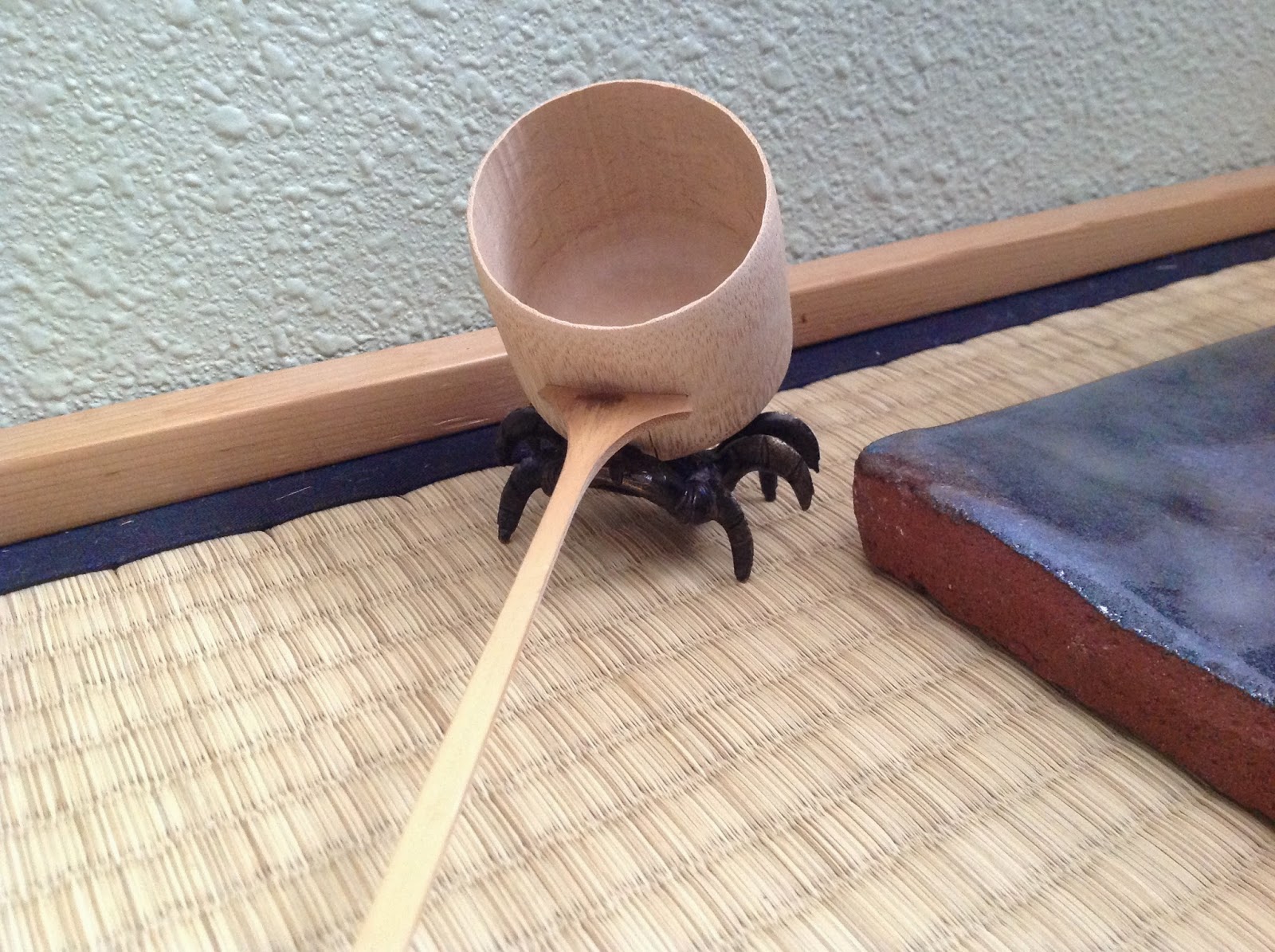
Kani futaoki -- crab lid-rest
The design of this lid-rest was adapted from the brush and sumi ink-stick rests of similar shape and size.  This futaoki is most appropriately used in spring and summer months.  The face of the crab determines the front and is used like any other futaoki by placing it on the tatami mat in line with angle of the hishaku.


Sazae futaoki -- turban shell lid-rest
An actual shell was used originally for this lid-rest, but was  replaced by ones made of metal and clay.  The front of the futaoki is determined by placing the pointed casing of the shell towards the fire.  It is placed in the kensui and used during temae with its underside up.  When displaying it on the tana, it is turned from right to left and placed with its underside down.

Hoyakoro futaoki - chalice shaped incense burner lid-rest
The design for this futaoki was borrowed from a lidded incense container used in Buddhist ceremonial rites.  It is used in both the ro and furo seasons when performing daisu or nagaita sokazari temae (the full display of utensils on the long board).  It is most frequently made of metal in either a five or six pointed cup design.  To determine the front, count the number of points and place one point in front if the number is odd, or two points front if the number is even.  The if this futaoki is closed when it is in the kensui, displayed the daisu or nagaita.  When it sis used it is handled like an old Japanese book -- opened from left to right and closed from right to left.  During koicha temae, the lid-rest is closed when it is not being used to support the kettle lid or hishaku.

Ikkanjin futaoki -- idle person lid-rest
This lid-rest is placed face forward, right side up in the kensui and on the tana and on its side when it is being used to support the lid and hishaku.  The boy at the well is thought of as idle, because he relaxes when he works and works when he rests.  Tu use this futaoki, pick up the hishaku with the left hand, removed the futaoki from the kensui with the right hand.  Replace the hishaku on the kensui, steady the futaoki on the left palm, turn on its side so that the boy's head will face the direction of the fire after it has been placed on the tatami.   Just the opposite of holding his feet to the fire.

 Mistuningyo futaoki -- three Chinese dolls lid-rest
The mitsuningyo futaoki probably pre-dates Rikyu as Chinese celedon examples have been found in Japanese collections.  This lid-rest may be used year-round. The doll dressed differently from the others is placed to the front.

Mitsuba futaoki -- trefoil lid-rest
This lid-rest resembles the edible trefoil plant and is used in the spring and summer months.  In the kensui and during temae, it is placed with the larger side up, with one single leaf to the far side.  To display it on the tana, it is turned over from right to left so that the larger side is down.

Gotoku futaoki -- (five virtues) trivet lid-rest
The gotoku futaoki is also called kakureiga (retreat) because the base is hidden in the ash.  It is used in the ro and furo seasons when the kettle is suspended (tsurigama), or rested on blocks (sukigigama), or directly on the brazier (kirikake buro).  It is placed in the kensui and used during temae with the circle side up and one leg to the far side.  At the end of the temae, it is turned over, right to left, and displayed with the circle down.

This is a good reference for the Rikyu no nanashu no futaoki, and I hope you all have a chance to use them in the future. 

Apr 30, 2014

NEW Class! Beginning Chado: Tray Style

The Beginning Chado: Tray Style class begins on Wednesday May 7.
.
In this class, students are introduced to the principles of making tea, including how to fold fukusa, purification of tea utensils and closing procedures.

Students will also learn good mizuya habits, as well as preparation of the tea room, and cleaning up.

There will be more emphasis on the guest role and we will cover topics such as flower arranging for tea, making sweets, kimono dressing  and other cultural studies.

It is helpful to have taken the Introduction to Chado class, but not necessary. Please bring  Fukusabasami (guest kit) and white socks to class.  If you do not have a fukusabasami, one will be provided.


Beginning Chado: Tray style
Wednesdays 7-9 pm for 10 weeks, starting May 7, 2014
Fees:  $250
Issoan Tea Room, 17761 N.W. Marylhurst Ct., Portland, OR 97229
Instructor: Margie Yap

Please reserve your place now,  with a $50 deposit,  in the left hand column.  Balance due at the first class.

If you have questions, please email Margie, or call 503-645-7058

Feb 9, 2014

Elevate your temae

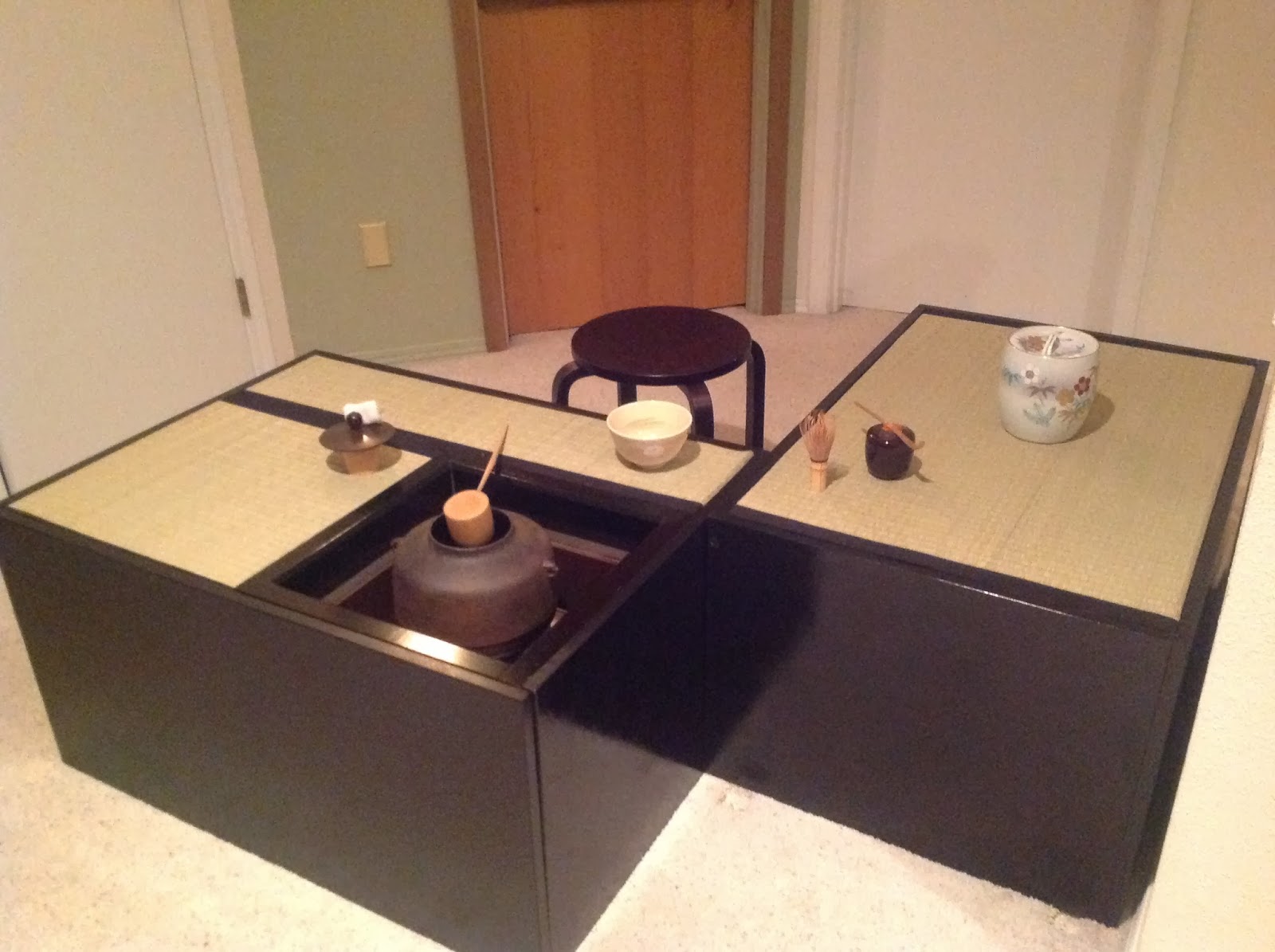
I have a few students who can no longer sit seiza on tatami.  Some of them are sad because there are only a few table style temae you can do.  And there is no difference in the seasons for table style.  So I had a plan for them.

In Portland, we have been rather snowed in for the last three days.  That means that Mr. Sweetpersimmon has been in the shop and I have been at the sewing machine.  Look what we completed this week.  I asked my husband to build me a tatami table so that my students who cannot kneel can sit and make tea on stools.  From photos and diagrams he designed and built not only a tatami table, but a table that can fit a sunken ro.  He also designed the two tables to be portable.  They fold up into two boxes.  Not only that, he made the right hand table so that it can be changed out for the furo season. This means that we can do any temae on this table.  Which is good, because he will soon close the tea room for phase 2 of the renovations, and we can still have class on the tatami table.

Portable elevated tatami with sunken ro


Jan 30, 2014

White Clouds

When choosing the toriawase, the arrangement of utensils for a chakai, or chaji the first thing you should consider is the scroll.  It sets the theme for your event and gives the guests something to think about.  Most scrolls displayed in the tea room are zen phrases written by Zen priests, monks, or abbots.  They can also be written by Zen scholars, spiritual leaders or person of inspiration.

When we enter and bow before the scroll, we are not bowing to the scroll itself.  We are bowing to the person and the spirit of the person who wrote it.  We look at the writing, which may not be the most readable, nor the most classical of script, but embodies the person who wrote it at the time they wrote it.  Observe the darkness or lightness of the ink, the wetness or dryness of the brushstrokes.  Are the strokes bold or delicate?  Do they convey movement or stability? All of these things and more can be observed by just looking at the calligraphy.  And of course you can admire it as a work of art.

The scroll hung at Hatsugama this year was written by Eido Shimano Roshi of Daibosatsu.

It reads:  Haku un onozukara kyoraisu
The English translation may be:
White clouds come and go of their own accord, or White clouds of themselves come and go

Like all Zen phrases, it may have many and deep meanings, so as a host, it would be good not only to read it when the first guest asks you to, but also to talk a little bit of what it may mean to you.  For example,
"White clouds come and go by themselves may mean that we cannot stop nature from doing what it wants, and in my life, trying to control everything is not productive, we have to let the white clouds come and go of their own accord."

In the gomei discussions, (also this post) I suggested that Zen phrases are good places to look for gomei.  "White clouds" or "come and go" can be used for gomei, and then you can recite the phrase from which the gomei is taken.

There is also a companion phrase to go with this one:  Seizan moto fudoo
The English translation may be:
Blue mountains by nature are immoveable, or blue mountains are steadfast

So if you hang the scroll haku un onozukara kyoraisu,  a very good gomei for the chashaku may be "seizan" blue mountains from the companion phrase, and then you can look like a sophisticated scholar.

As a reward for those of you who have read all the way to the bottom of this long post, I have a bonus for you.  Not all scrolls you may purchase on eBay have a scroll box.  To protect your scroll from damage and also to show some reverence for the spirit of the person who wrote it, here is a project plan for making a a scroll box of cardboard.  You can make it any size to fit your scroll perfectly. Then you can come and go as you please.


Dec 31, 2013

The joy of tea

Today I had the lucky opportunity of hosting a chakai for people that I had never met.  However these two people had traveled many thousands of miles from North and East of here to be my guests.   They were graduates of the Midorikai program in Kyoto and attended about 5 years before I had gone myself.

One of  my guests had not done tea for about 20 years and the other one had kept in practice even though there were few tea people to share tea where he lived. 

I started preparations earlier in the week cleaning my house top to bottom.  I cleaned, swept and vacuumed. I dusted, wiped and washed.  This morning in the quiet, I zokined the tatami and put the fresh kettle on.  As it heated, I prepared my utensils:  Unrolled the scroll and hung it carefully.  I sifted the tea and rinsed and dried the teabowl, mizusashi, and kensui. I soaked the new chakin and opened a new chasen. I arranged the utensils just outside the tea room.

Then I went to make the sweets:  White kinton with green interior.  Gomei - yukima no kusa

I cleaned the toilet, put out the tsukubai, picked and arranged the flowers.  Then I filled the natsume, arranged the sweets and went to put on my kimono. As I dressed, I thought how lucky I was to be able to host two experienced tea people who were hungry for the experience!

I went to check the kettle and it was beginning to sing.   My student came to assist, and he once more zokined the tea room,. put on his kimono and went out to wait for the guests.  He greeted them outside and assisted them inside to take off their shoes and hang up their outer garments.

Surprise, one guest wore his kimono!  Up in the tea room, the incense was lit and wafted down to greet the guests. They entered the tea room and we made them comfortable.  What a joy to make tea for these guests who appreciated everything and noticed the smallest details.  The conversation was easy and natural, the tea was made and drank.   They even had two bowls of tea each.

After everyone got feeling back in their feet we sat just outside the tea room and visited, but like very good guests, they didn't stay long because they knew we had things to do.

My student and I had a bowl of tea  and then cleaned up, closed the tea room and said goodbye. It was a very satisfying and fulfilling experience.   This is why we study the way of tea.


Apr 24, 2013

New Class: Beginning Chado

As an instructor of Chado, I am continually thinking of ways to pass on what I have learned and instill in my students the enthusiasm and joy that I feel in the way of tea.   Being connected to the rich history of chado and honoring all of the efforts my own teachers have invested in me, make me glad that I have found a passion in life that I can share with others.

I have developed a new class for students who have taken the Introduction class and would like to continue.

Beginning Chado class.  It will begin Friday, June 7 from 7-9 pm, and run for 10 weeks.  In this class students will learn a complete tea ceremony procedure called ryakubon, or tray style.  It is a complete tea ceremony with all the essential elements, but you can do it without a lot of equipment or tea room.  I have shared tea this way for public presentations, and also while hiking, in the living room, on the train, in my hotel room while traveling and under the cherry blossoms.  Students will also deepen their understanding of the guest role, learn to make different types of sweets, and learn basic preparation and set up of the tea room.  We will begin to explore seasonal aspects of the tea ceremony, and at the end, put on a tea gathering for friends and family.  Come join us for this class.

You need not have taken the Introduction to Chanoyu class, but it is recommended.  For those interested, please reserve your place by using the Paypal button to the left, or contact Margie 503-645-7058, margie@issoantea.com.

Apr 22, 2013

The last of the Sakura

To my regular readers, I am sorry that I have not posted in so long.   I promise to post more regularly in the future.

In the meantime, Sakura season has come and is nearly gone.  The late cherries are dropping their petals like snow and it is getting warm and sunny here in the Pacific Northwest.

There have been so many activities the last few months, from Girl's Day to the Camellia Festival and Sakura Festival demonstrations.  We had a visit to Portland from Soujuan Kimono from Kyoto and got a kimono dressing lesson.   The Friday night Introduction to Chanoyu class had their final chakai at the Portland Japanese Garden, and the advanced students are now studying chabako.  Also students Colorado visited Issoan and we had several sewing classes for our practice kimono. The Saturday Introduction to Chanoyu had their calligraphy class, incense and poetry class, and tea bowl appreciation class.  Only 4 more lessons and they, too will have their final chakai.

With that, I am announcing the Beginning Chado class.  It will begin Friday, June 7 from 7-9 pm, and run for 10 weeks.  In this class students will further their training on the guest role, learn how to purify utensils, make sweets, serve tea from the kitchen with goal of conducting a basic tea ceremony in the ryakubon, or tray style.  You need not have taken the Introduction to Chanoyu class, but it is recommended.  For those interested, please reserve your place by using the Paypal button to the left, or contact Margie 503-645-7058, margie@issoantea.com.

Jan 19, 2013

Shogatsu 2013

The Portland Japanese Garden Shogatsu celebration, where we made tea for the public with the Misonodana.