Showing posts with label fabric. Show all posts

Aug 31, 2012

Workshops for Tea Ceremony


Thursday, October 4, 2012 - 6:00pm :
Japan and the Culture of the Four Seasons - Nature, Literature, and the Arts, (click link for more information)
Portland State University
We plan to dress in kimono, attend the lecture and have a snack afterwards.  Please join us.


Saturday October 6th, 10 am to 2 pm 
Kimono alterations class 
Issoan Tea Room
Kimono too short?  Not wide enough?  Kate has been successful in altering kimono to fit differnt body shapes. Bring your kimono to work on.  She will teach us how to measure for kimono, where to add length, how to widen side seams and much more.   We  will also learn proper fitting and kimono dressing.  Please join us.  Call Margie to register 503-645-7058


Saturday October 13, 10 am - 2 pm 
Field trip to the Bamboo Gardens
North Plains
We will meet at Issoan Tea School and carpool to Bamboo Gardens where we will tour the garden, learn about bamboo cultivation, and how to work the bamboo for crafts.  This will be  good in preparation for chashaku carving and flower vase making workshop later this year..  For reservations and carpool information, call Margie 503-645-7058


Sunday October 14th, 10 am
Completion of Kimono alterations class
Kate 's house 
After homework assignment, we will complete our kimono alterations. (bring sewing machine if you have one).  If there is interest, we may have ongoing sewing workshops including sewing a kimono from scratch, shifuku making workshop and making bags for chabako.  Please call Margie to register.  503-645-7058

More workshops to come

Aug 29, 2012

Kobukusa Magic

We had a kobukusa making workshop a couple of weeks ago, and I promised that I'd post pictures from the workshop.  We had 4 participants, and Kate was our teacher.  She supplied silk fabric, silk thread, needles, patterns, instructions and sewing advice and help.

Everyone who had brought their sewing kits, supplies and eagerness to learn.


We started with the fabric, pattern and instructions:

Measured and pinned:


Stitched: 

Pressed:

Turned with a little bit of kobukusa magic we had a finished product.


Aug 6, 2012

Kobukusa making workshop at Issoan Tea


Date: Sunday, August 12, 1-3 pm
Where: Issoan Tea School 17761 NW Marylhurst Ct. Portland, OR 97229
Make reservations by Friday August 10, 5 pm. 503-645-7058
Fee: $10

We are lucky to have talented students at Issoan.   This Sunday August 12 there will be a kobukusa making workshop from 1-3pm at Issoan Tea. That little square of brocade cloth is used in many instances such as serving tea from the kitchen, haiken, displaying utensils and intermediate and upper temae.

Kate has generously agreed to teach the workshop and will be providing practice fabric, patterns and teaching the workshop.  Bring  a sewing kit if you have one.  If you do not, we will supply everything.   Please call to make your reservations for this workshop by Friday evening, August 10, 503-645-7058.

Stay tuned we have other workshops planned for this fall.

Jun 27, 2012

Meibutsugire part 4 Kanto

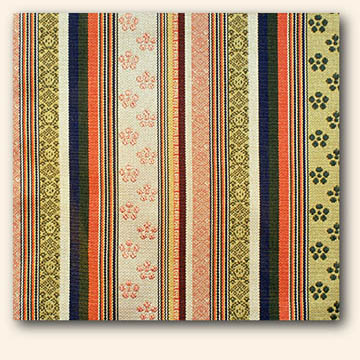
Fabrics with stripes, plaid or checked patterns are called kanto. There are different reasons why fabrics with certain patterns can be considered kanto fabrics, and no clear rules exist for classifying them.

In the 16th centry, when kanto fabrics were introduced into Japan, the striped and checked patterns felt new and fresh to chajin (Tea practitioners). From that time on, they were used for making pouches for chaire (thick tea container), considerably earlier than donsu and kinran. Even after donsu and kinran became highly valued, the use of kanto fabrics did not decline because they provided a new range of fabric colors.

Here are a few examples:

Aoki kanto
 The name of this fabric comes from its original owner, Aoki, who was Toyotomi Hideyoshi shogun's retainer.

Kapitan kanto

Kapitan kanto with large stripes

Mumei kanto
Sushuji kanto
Tosai Kanto (10 colors)


Nikuzushi kanto
Nikuzushi kanto close up


All three above: Sagara kanto

Yoshino kanto
 It is said that Lady Yoshino favoured this pattern for her Uchikake, a coat dress. She was a wife of Haiya Jyoeki, a rich merchant who lived in Kyoto in 17th century.
Yoshino kanto
My sensei had a beloved bunrin chaire with a shifuku made of this kereji in these exact colors.  We used it for many years until she passed away.  We don't know what happened to the chaire, but it remains one of my favorite fabrics.


*Fabric photos courtesy of  Kitamura Tokusai Fukusaten Co., Ltd., Kyoto, Japan.via the now closed website Tea Hyakka..


Jun 23, 2012

Meibutsugire part 3 - Donsu

Donsu , a damask satin. like kinran, comes in a great variety of patterns. It is a thick, lustrous fabric made of silk. It is not as dazzling as kinran, but rather has a quiet kind of beauty. The design is integrated into the ground and does not protrude from the surface of the cloth, as in other brocades.

The pre-dyed warp and weft threads are woven where one side of the cloth is warp faced and the other is weft faced and a design is made by reversing the face in the pattern areas.  Not all the meibutsugire fabrics caterogized as donsu have this weave structure. Some exceptions are woven with a twill ground. Since it is finely woven with strongly twisted dyed threads, the overall feel of the fabric is soft.. Chajin especially loved the quiet patterns and pliability of donsu, and for this reason, many chaire pouches have been made with it.

Some examples:

Ariso donsu

Ariso donsu is an image of fish in the waves.  You can also see this motif in the ariso tana and on other tea utensils.


All of the examples above are called Iyosudare donsu.  The name comes from the rred blinds caled iyo sudare.  The design usually consists of stripes with various treasures against a checkeboard ground, or plum blossoms.  The original fabric had both treasures and blossoms in one continuous fabric, but you can see both designs separately.  This fabric was made into a shifuku for the chuko meibutsu chaire called "Sokushiki"

Hosokawa donsu

Hosokawa donsu was owned by Hosokawa Sansai (1564-1645) who was one of Rikyu's seven students.

Soami donsu
 Soami served the shogun Yoshimasa Ashikaga in the Higashiyama period (1435 –1490) as a sort of curator (dobushu) of Yoshimasa's collections.


Kamakura donsu

 
Rikyu-bai donsu
The name Rikyu-bai donsu actually comes from the similarity of the plum blossom motif with the flower known as Rikyū-bai.  This cloth was used by an Edo period tea master to make a shifuku for a black chū-natsume [lacquered tea-container] which bears Rikyū’s signature in red lacquer on the inside of the lid; as a result this cloth is commonly, but mistakenly, understood to have been favored by Rikyū (forgetting that Rikyū died in 1592, while the Ching Dynasty was not founded until 1616).  The cloth itself, a similar textile (featuring a plum-blossom motif in ocher on a dark-blue background) is occasionally encountered under the name Riky-bai donsu. The true Rikyū-bai donsu has a plum-blossom motif which fits into an oblong diamond (though this is not so obvious at a glance, since the design has five points rather than four), while the other (which is actually based upon the ori-dome, or woven-on cover, of the striped Iyo-sudare donsu (see above)has a plum-blossom which fits into a circle (thus it is shaped like a regular 5-pointed star).

Oribe donsu

Oribe donsu is said to be in the taste of Furuta Oribe, a disciple of Rikyu.  On a deep, quiet blue ground, the light yellow-green waves stand out, with plum blossoms floating on them.  Oribe was very fond of plum blossoms as he used that motif in his designs for ceramics and other fabrics.

Sokun donsu
 This example of a geometric pattern is sometimes known as shippo tsunage, or interlocking seven treasures.  The treasure elements appear in varied form on a blue background in the center of the circle with plum blossoms. The name of this fabric comes from its original owner, Imai Sokun. Sokun, son of Imai Sogyu, was a tea master in the end of the 16th century begining of the 17th century.

Sumiyoshi donsu
Sumiyoshi donsu is a geometric triangular design.  It was used as a pouch for a thick tea caddy called "Sumiyoshi Bunrin" Chaire.

Mozuya donsu
It is said that Mozuya Soan, who was a merchant in Sakai, Osaka and Sen Rikyu's daughter's husband, possesed this fabric.

Sasazuru donsu
 Designed with the auspicious pine-bamboo-plum motif  (shochikubai) symbols of long-life, nobility and hope). Sasazuru donsu has many different variations.


*Fabric photos courtesy of  Kitamura Tokusai Fukusaten Co., Ltd., Kyoto, Japan.via the now closed website Tea Hyakka..


Jun 16, 2012

Meibutsugire part 2 Kinran


Kinran(gold brocade) is considered the most gorgeous of the meibutsu-gire. The first syllable of the word, kin, means "gold". the second, ran, refers to cloth that was attached to the hem of a Buddhist cloak to strengthen it.  Kinran has a ground wave of twill and weft patterns woven with either gold thread or threadlike strips of gilded paper.  Kinran was first made in China (known as Zhijin) during the Song Dynasty. It came to Japan through Sino- Japanese trade at the end of the Fujiwara and Kamakura periods, in form of ceremonial robes for Zen monks. Kinran began to be made in Japan during the Momoyama period. 

Below are some of the more well know kinran fabrics and patterns:


Futari Shizuka Kinran

The name of this fabric comes from a Noh play called Futari Shizuka. It is said that Ashikaga Yoshimasa shogun (1436-1490) performed this particular play wearing a costume made of Futari Shizuka Kinran fabric. Late Sung period - early Ming period. 

Daito Kinran
Daito kinran has a design of auspicious clouds.  Daito kinran is popularly believed to be the fabric used in the surplice of Daito Kokushi, the founder of Daitokuji (temple) in Kyoto, Sung period.


Osaka Kinran
Osaka kinran is named after the shifuku used with the Osaka Marutsubo chaire, from the Ming period.


Wakuda-de Kinran
Wakuda kinran has a design of waterfowl in a lotus pond.  Named for the owner of the fabric, from the Ming dynasty.


Shippo Setsugekka Kinran

Shippo Setsugeka Kinran is a design of interlocking rings, with snowflakes, moon and flowers, favored by the Urasenke14th Generation Grand Tea Master Tantansai.


Hariya Kinran
 Hariya Kinran was named after the shifuku used with the Hariya Katatsuki chaire owned by Hariya Soshum. Also called fish scale pattern.

Itoya Kinran
 Itoya is a design of jeweled wheels on a basket weave background.  It is often woven as a futusu, or double weave fabric where the opposite colors appear on the reverse side.  Where blue appears on one side of the cloth, yellow shows on the other and between them a pocket is created.  Futsu weave is named for "breeze funnel" and derives from the empty space between the two faces of the fabric.  If this were woven with gold thread it is "Itoya futsu kinran."   The fabric name comes from the cloth owned by Itoya Ryotei, who lived in Kyoto in the 16th century.  This fabric was made into a shifuku for the chaire named "Sogo nasu."  This fabric was first made in China, probably, Ming dinasty around 1573-1619.

Hanausagi Kinran


Hanausagi Kinran
Chaji Hanausagi Kinran

Moegiji Hanausagi Kinran

Suminokura Kinran
 The previous five fabrics are variations of a cute rabbit standing on its hind legs looking back at some blossoming trees.  The last one is named Suminokura kinran for the wealthy Kyoto merchant Suminokura Ryoi, who was particularly fond of that kind of design, the difference is that the pattern is bigger than Hanausagi Kinran.

There are many other famously named kinran fabrics, but you can begin to recognize these fabrics in your study when the guests ask about shifuku kereji.

*Fabric photos courtesy of  Kitamura Tokusai Fukusaten Co., Ltd., Kyoto, Japan.via the now closed website Tea Hyakka..