Showing posts with label Chado. Show all posts

Apr 13, 2015

My first chawan, ichigo ichie

I think I had been studying for about 3 years when I thought I would like to acquire my first teabowl.  In those days there was not the internet nor eBay to purchase utensils.  So we had to ask someone to buy it for us in Japan or find some other way of acquiring utensils.  I used to haunt antique shops and estate sales because living on the Pacific rim there were many people who have traveled to and from Japan.

Not the original bowl but similar
In an antique shop one day I found a modest brown and white chawan.  Though I went to look at it several times, I didn't want to buy it yet because I didn't know if it was a good one or how much I should pay for it.  In those days, I wasn't making much money and the $40 price tag was rather a large commitment for me.  I asked my sensei to look at it and give me her opinion.  So she went to the shop and talked with the owner and came back and told me it was a good bowl for me to get and that she had negotiated the price to $30 because I was her student.  Yay!

I went the the shop and purchased the bowl (it had no protective box) and brought it home. I was so happy.  To thank my teacher, I gave a chakai and invited her to tea at the tea house at the Japanese garden.  It was a lovely chakai, and sensei said that the bowl had presence and she was glad to drink from it.

At home, after the chakai, I was unpacking the car.  The tea bowl slipped out of the protective wrapping and dropped to the driveway, shattering into dust. There were so many small pieces, I could not even pick them up.  I had to sweep them into a dust pan. There was nothing left to save.  Truly ichigo ichie.  But at least sensei got to drink from it one time.

Mar 25, 2015

Sensei says. . .

Wa, kei, sei, jaku: harmony, respect, purity
and tranquility
Many of these sayings have appeared in the blog before, and students will recognize many of them from my own teachings. I have gathered them together to best of my recollection.  I hope you can add your own "sensei says" in the comments.

The term “sensei” has been translated as “teacher.” Quite literally from the kanji, the term “sensei” means “one who was born before.”  If there is great wisdom, it is gained through life experience and wisdom imparted by their “sensei” born before them, going back through 400 years of Tea tradition.

My apologies to sensei for any mistakes due to the differences in Japanese and American culture and language. I am glad that someone was born before me to point the way. These words of wisdom, were spoken to me in class rooms and tea practice rooms by sensei who cared enough to help me develop in Tea and in life.

On life and Tea:

Wa, kei, sei, and jaku are easy in the tea room.  The hard part is making it essential in the rest of your life.
Tea becomes much more than a hobby or social event.  It becomes a lifestyle.
Tea becomes the yardstick with which you measure your life.
The attitude of gratitude is essential.
Don’t get ahead of yourself. Complete this moment before going on to the next.
Don’t expect, just adjust.
Tea is where you realize your own religious beliefs.
What makes us uncomfortable makes us stronger.
People who endure hardship in life become tougher, like misshapen charcoal, they last longer than those with an easy life who burn out quickly.
Tea is movement.  It gets us out of our heads, into our bodies, so we can touch our souls.

On learning:

You can not learn Tea by reading a book. You learn Tea by training your body and to do it well, you must do it at least a thousand times.
Every time you do Tea, you learn something about yourself, even though you may have done it many, many times before.
Tea is not a thing to learn from teachers. The things you seek are already within you.
The existence of the teacher is more important than what he/she says, does or writes.
Learn with more than your brain. Observe, train your body, ask your spirit and relate to your guest.
Before you ask your teacher a question, look and observe.  Try to figure it out on your own. You learn so much more that way.

On making mistakes:

You can do nothing right in class, but in chaji (formal tea gathering)you can do nothing wrong.
If you are going to make a mistake, make it beautifully.
There is no going back, just move forward.
There is no such thing as the perfect temae (procedure for making tea). Doing it perfectly is not the heart of Tea. Doing it as if it was the first time, finding interest and excitement like finding interst in your life, to avoid being jaded, that is the true heart of Tea.
The Tea room is a place where we abandon shame. Do not be afraid to make mistakes if you want to learn.

On form:

When you have mastered the forms, then you become free from the forms.
Learn the kata (form).  When you know it thoroughly it becomes your katachi (style).
The body learns the form: it learns the discipline until it goes beyond the rules and becomes natural.
First master the form. The form is a vessel for the content.  You need a strong vessel to hold what goes inside or it leaks away.

On training:

Awareness is not concentration.  Tea is training in awareness
Tea training also teaches us how to receive.
Every time you make a bowl of Tea, it is not practice Tea it is the real Tea.
In training for Tea heart and spirit, as you gain maturity, learning and knowledge, the rules and guidelines change into a total experience of life.
The most difficult training is not temae, but to watch your mind and your behavior when you encounter nasty tasks and people.
Every difficulty you encounter is good training for you.

On doing the work:

Do the work. Tea is not for the lazy.
There are no trivial tasks in Tea.
There are no shortcuts in Tea.
Cleaning is 80% of Tea.
No matter how accomplished you get to be in Tea, cleaning the toilet is always the host’s job.
The mizuya (preparation room)should be clean enough to eat off the floor.
The mizuya (preparation) work should be done as if it is temae (tea making procedure).
It is your own responsibility to get to the heart of Tea.
With Tea, we are sitting on a mountain of jewels, but you must do the work and dig them out yourself.
You should do everything right because it is the right thing to do.

Feb 25, 2015

More sweets

Here are few photos of sweets made by students.  I am especially charmed by the little green frog.


From SweetPersimmon

Jan 9, 2015

The art of the thank you note


As a child, my mother sat me down when I received any gift or attended any event to write a thank you note.  It was drilled into me that I MUST acknowledge what someone else had done for me by a hand-written thank you note.  That training has stood me in good stead.   It is very seldom these days that we receive a thank you note from anyone.  It is so unusual that I have received thank you notes for sending a thank you note.

As part of the etiquette of attending a chakai, the thank you note from the guest to the host after the event is essential.  I have written and received many, many thank you notes and there is an art to writing a thank you note.

As you can see from the example above, the thank you note doesn't have to be very long.  This example is very sophisticated and perfect for the occasion.

After the greeting, there is an acknowledgement of what the person is thanking you for.  The next sentence is making a specific comment about what the person enjoyed, and how they enjoyed it. The next comment is something that they learned that they didn't know before, and finally how the event affected them.  Closing we have another expression of thank you (in Japanese!) and a simple sincere closing with signature.

As  you can see, it is a handmade card. If you have an appropriate card, please use it.  A handmade card will do just fine.  A blank paper will do as well.  You just need to take the time, and address it, put a stamp on it and send it off.

Here is another example of a thank you note I received for Hatsugama:

Dear Margie
It was such a wonderful Hatsugama chakai this afternoon., and I feel calmness settling in my heart as I reflect on the gathering.  I'm fortunate to be surrounded by treasures of tea friends and wonderful tea utensils.  The Spring Bulb bears much energy to grow, I look forward to pursuing Chado together and growing further.  Thank you for setting a springboard, gracefully prepared, for me take the great first step of the new year.
Best regards,

The author of this thank you note incorporated the theme and names of the utensils into the thank you note.  Spring bulb was the shape of the chaire, and "first step" was the gomei of the chashaku. It shows that the guest was paying attention and how it affected them.

Please do not waste time in sending your thank you note.  Sit right down after the event (as the author above did right after the event. I received this in the mail the very next day).   If you have procrastinated more than a week in writing your thank you note, do not just forget about it. Sit down and write it now.

Finally, for those who struggle for words on paper,  it is the thought that counts. Write what is in your heart. A sincere thank you is the most appreciated.

Dec 14, 2014

Kids and the way of tea

I recently presented chanoyu to a group of third graders, that is 8 and 9 year olds at their classroom in Portland.  I had them pretend that they were Japanese students and they all stood up and said "Ohaiyo gozimasu, sensei" to their teacher, and they were very attentive and nearly silent during the 30 minute presentation.  We talked about wa, kei, sei and jaku: harmony, respect, purity, and tranquilty.  These kids got it:  Being nice to each other and getting along; please and thank you, wash your hands before you eat, and quiet time. 

They all waited with their sweet in front of them until I invited them to go ahead and eat your sweet.  And I passed a teabowl around the class and they were so careful in handling it, looking at the "face" of the bowl.  And what I loved was the questions, about Japan, Japanese students, my kimono, what the red cloth meant.  I really enjoyed myself.

The students got to taste mugi cha, since there isn't caffeine, but they got to see their teacher be a guest and drink the matcha, while they were silent "ghosts" just watching and observing. 

The best part of all, I received a packet of thank you notes, see a sample of them below:


Dec 8, 2014

All in

All in is used in poker (Mr. Sweetpersimmon is a poker dealer) to bet everything you have.  There is nothing in reserve, you either win it or you are out.  How does this relate to chado?  When people say that they want to be present in the tea room ... it has to be all in.  Either you are present or you are not. You have to be all in.

A lot of the ritual of chado is help the guest (and the host too) become present.  As we enter each doorway or gate, we leave something of the world outside.  The traffic, school work, your mother-in-law, each and every time you step through a doorway you become less and less burdened. As you put on your white socks, you put on your being present cloak, as you rinse your hands at basin, you wash more of your cares away.  As you come up the steps to the tea room you are elevating yourself from the dust of everyday life, so that by the time you enter the tea room, you can be present -- nothing matters so much as what is happening at this very moment -- you are all in.

Sometimes, especially at night after work, we do about 10 minutes of zazen before we start class.  This also helps us become quiet, slow our breathing, and ready for class.  Just 10 minutes where your breath is the only thing that matters. 

Maybe it is possible to become present any night of the week.  As you leave work, you pass through doorways, you can leave work at work. As you drive home in traffic it can become your zazen.  When you finally open the door and enter your home you can be all in, fully present.

Oct 29, 2014

Rikyu's futaoki

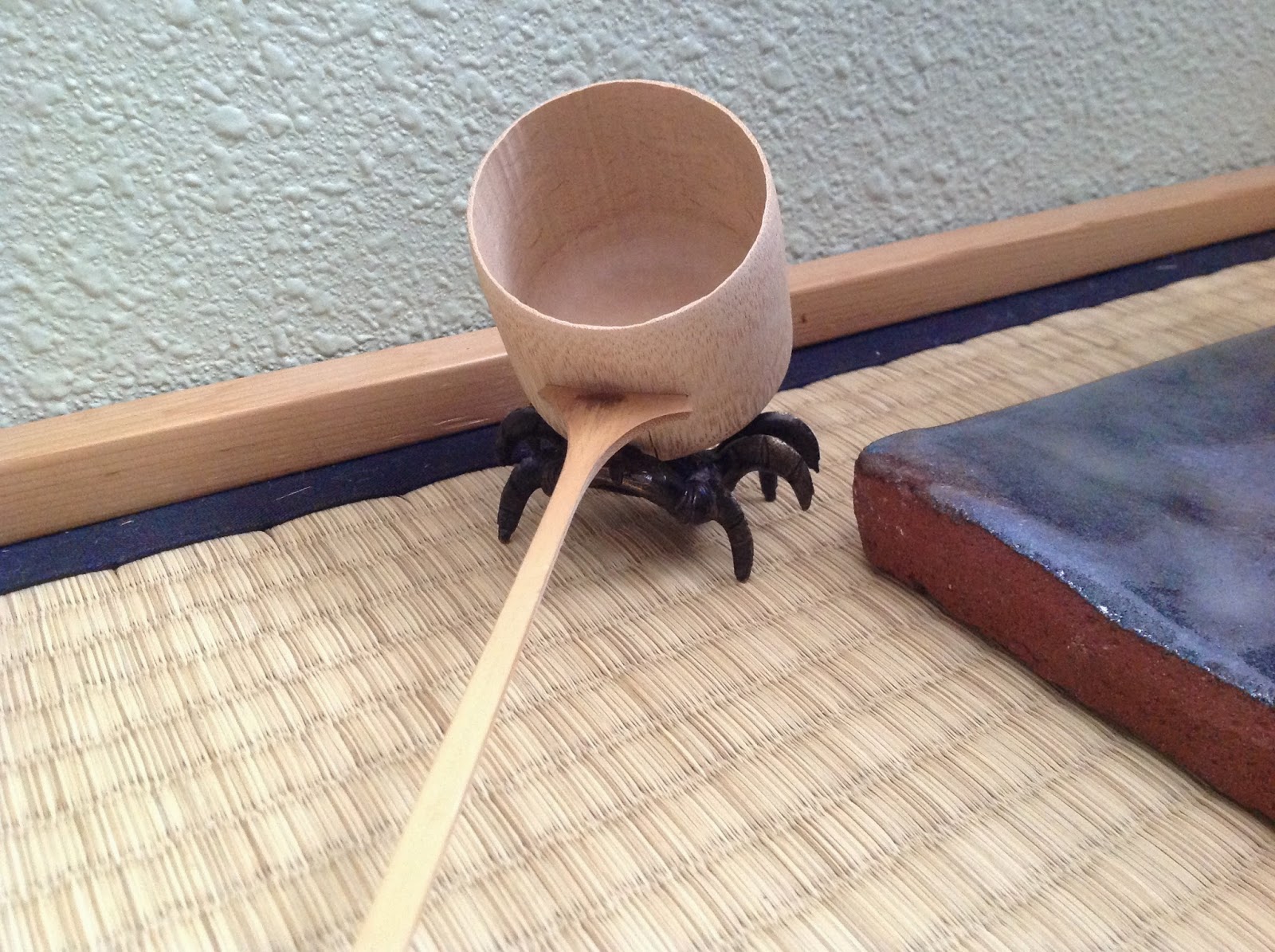
We have been practicing with a variety of dogu this year in the intermediate classes.  I have a bronze set of the 7 futaoki supposedly favored by Rikyu. (Rikyu no nanashu no futaoki).  A futaoki is a kettle lid rest, and also can be used to rest the hishaku.  These are ways to handle and display the futaoki that I have been taught:

Kani futaoki -- crab lid-rest
The design of this lid-rest was adapted from the brush and sumi ink-stick rests of similar shape and size.  This futaoki is most appropriately used in spring and summer months.  The face of the crab determines the front and is used like any other futaoki by placing it on the tatami mat in line with angle of the hishaku.


Sazae futaoki -- turban shell lid-rest
An actual shell was used originally for this lid-rest, but was  replaced by ones made of metal and clay.  The front of the futaoki is determined by placing the pointed casing of the shell towards the fire.  It is placed in the kensui and used during temae with its underside up.  When displaying it on the tana, it is turned from right to left and placed with its underside down.

Hoyakoro futaoki - chalice shaped incense burner lid-rest
The design for this futaoki was borrowed from a lidded incense container used in Buddhist ceremonial rites.  It is used in both the ro and furo seasons when performing daisu or nagaita sokazari temae (the full display of utensils on the long board).  It is most frequently made of metal in either a five or six pointed cup design.  To determine the front, count the number of points and place one point in front if the number is odd, or two points front if the number is even.  The if this futaoki is closed when it is in the kensui, displayed the daisu or nagaita.  When it sis used it is handled like an old Japanese book -- opened from left to right and closed from right to left.  During koicha temae, the lid-rest is closed when it is not being used to support the kettle lid or hishaku.

Ikkanjin futaoki -- idle person lid-rest
This lid-rest is placed face forward, right side up in the kensui and on the tana and on its side when it is being used to support the lid and hishaku.  The boy at the well is thought of as idle, because he relaxes when he works and works when he rests.  Tu use this futaoki, pick up the hishaku with the left hand, removed the futaoki from the kensui with the right hand.  Replace the hishaku on the kensui, steady the futaoki on the left palm, turn on its side so that the boy's head will face the direction of the fire after it has been placed on the tatami.   Just the opposite of holding his feet to the fire.

 Mistuningyo futaoki -- three Chinese dolls lid-rest
The mitsuningyo futaoki probably pre-dates Rikyu as Chinese celedon examples have been found in Japanese collections.  This lid-rest may be used year-round. The doll dressed differently from the others is placed to the front.

Mitsuba futaoki -- trefoil lid-rest
This lid-rest resembles the edible trefoil plant and is used in the spring and summer months.  In the kensui and during temae, it is placed with the larger side up, with one single leaf to the far side.  To display it on the tana, it is turned over from right to left so that the larger side is down.

Gotoku futaoki -- (five virtues) trivet lid-rest
The gotoku futaoki is also called kakureiga (retreat) because the base is hidden in the ash.  It is used in the ro and furo seasons when the kettle is suspended (tsurigama), or rested on blocks (sukigigama), or directly on the brazier (kirikake buro).  It is placed in the kensui and used during temae with the circle side up and one leg to the far side.  At the end of the temae, it is turned over, right to left, and displayed with the circle down.

This is a good reference for the Rikyu no nanashu no futaoki, and I hope you all have a chance to use them in the future. 

Sep 6, 2014

My First Chakai

I'd like to introduce to you a guest blogger, Stephanie.  She is a student and has been studying for more than 2 1/2 years.  Earlier this year, she put on her first chakai:

Earlier this year I hosted my first chakai (tea gathering) for a fellow student who was returning to Japan. It was fitting that she be shokyakyu (first guest) and I teishu (host) since we had studied together for several months. My senpai (senior students) helped me plan and even agreed to be hanto (serving the tea in the tea room) and mizuya-cho (preparing everything outside of the tea room). One of my senpai painted the artistic work on the front of the invitation! I am so fortunate that Margie sensei encourages us to host chakai and for generous senpai!
 
Margie Sensei and Honored Guest
One of the best things about planning a chakai is that it's an integrative learning experience. It allowed me to take the individual learnings from my lessons and bring them together in a whole. Part of the learning, for me, was figuring out what needed to be done and when. For example, I needed to decide upon the guest list; select a theme; make and send the invitations; purchase fresh tea, whisk and chakin (linen cloth for purification); select the utensils and appropriate poetic names; write up the kaiki (a list of the utensils with names); decide upon and make/procure sweets and much more.
 
Tea Bowl Name: Haru Gasumi, Spring Mist, named by First Guest
I also wanted to honor my friend and teachers by doing my best at making tea and so I practiced the temae (tea procedure) many times at home, until I could more or less complete it without egregious error. I aspired to a place of familiarity so that I could also speak during the tea-making. This can be a challenge, but an important one as much of the theme is revealed through the stories told. I believe that practice is always a worthy path and it has paid off for me in multiples, as my comfort with the basic procedure has grown tremendously through the experience.

The day of the chakai, my senpai and I arrived early. They were so wonderful, I can't say thanks enough! They helped me clean, wipe the tatami, hang the scroll, arrange the flowers, set up the utensils, etc. We even had time for a dry run which helped me feel much more at ease. One of my senpai dressed me in kimono (so that it would go faster than my 2.5 hour process!), and then the guests arrived. 
 
Stephanie (host, center) and Senpai
From this point onward, things unfolded in their natural order and I believe the experience was meaningful to everyone involved. My hands shook visibly as I placed the chashaku (tea scoop) onto the natsume (tea container) and I forgot to open the lid to the mizusashi (cold water jar) at the right time, among numerous other minor blunders. Margie sensei had trained me well to make my mistakes as beautifully as possible and carry on. My heart was filled with warmth to honor my friend and the other guests. The tea was made and served, the stories were told and the conversations were lovely, making for a once-in-a-lifetime tea gathering.

Aug 27, 2014

Summer chakai

The students from Issoan Tea put on their summer chakai last weekend.  I am going to post photos and kaiki.  It was a playful twist to the theme.

Here is a photo of the invitation:

"Stretches for light years,
Satellites transmitting
A mass of pitch black."
by James, published by NASA's Going to Mars Campaign 2013,
collected for the MAVEN Spacecraft launch
Front artwork by Michelle Kottwitz

MAKE IT SO
To celebrate friendship and a sci-fi classic, please join us for a light snack, usucha and sweets
Issoan Tea school
Sunday, August 24th
RSVP to Karla Tomanka or Margie Yap
Kimono not required. Being a trekkie not required.


Scroll


Flowers

Temaeza


Snack


Sake


Haiken 


Natsume

Futaoki


Chawan


Edited to add sweets, Tribbles made of an, communicators made of yokan


Star Trek Chakai 2014 Kaiki

Osayu:  Earl Grey tea, hot
Meal:  Three dish rice, miso and raw dish
Scroll: Shikishi "Engage" by Margie Yap
Hana: Seasonal
Hanaire: Bizen hyotan hanging vase
Temae: Arai jakin
Mizusashi:  Found object, metal box
Chashaku: "Live long and prosper"  carved metal family heirloom by George Takei, named by Leonard Nimoy
Futaoki: Cactus skeleton, by Randy Burks
Kensui: Hammered copper
Chamei: "Far point"  local blend
Sweets: Tribbles made of an, communicators made of yokan
Natsume: Black lacquer Rikyu-gata, medium size with stars
Chawan: Glass bowl "Amanogawa" (The Milky Way) by Kunihiko Hirohata
Kaejawan: Gold leaf bowl "Snow storm" by Hirota
Gift: Fish tile

Jun 22, 2014

Precious Resources

We are blessed in the Pacific Northwest with abundant, clean and good tasting water. We can drink our fill straight from the tap to quench our thirst without bad smells or off taste.  But recently the city of Portland had an alert that e coli was found in the water system and everyone was advised to boil water before drinking, brushing teeth or cooking. It happened during our 35th anniversary event, but at home as well I was reminded what a convenience good, clean water is straight from the tap.

When I was at Midorikai, our final chaji was at a tea room with no running water.  That meant we had to go the the well in the morning and haul two five gallon containers up the hill to the tea house.  Believe me, hauling 5 gallons in kimono uphill is a lot of work.  These 10 gallons were all we had to pre-wash everything, boil the water for tea, water the garden, and fill the tsukubai.  We were very careful with every bit of water and made sure that nothing was wasted. 

It is the same thing with matcha.  We are fortunate to have the convenience of pre-ground tea leaves sealed in an airtight container.  It takes about an hour to grind enough tea for a chaji, so I am sure that if I had to grind it myself, that I would be very careful about spilling and wasting the matcha when I sifted it or transferred it from one container to the another. 

We forget that these things: water, tea, electricity -- are all convenience factors. Part of living the way of tea is to recognized that most of what we use are precious resources and be very careful not to waste anything.  It is good for the environment, good for the planet, good for each other and good for our souls.