Showing posts with label study. Show all posts

Sep 7, 2014

Study in Japan

Fully Funded Japanese Government Scholarships for Foreign Undergraduate Students

Deadline: November 30, 2014

Applications are open for Japanese Government Scholarships available for international students to pursue undergraduate studies in Social Sciences and Humanities and Natural Sciences at Japanese universities. Scholarship awards will be tenable for five years from April 2015 to March 2020, including one-year preparatory education in the Japanese language and other subjects due to be provided upon arrival in Japan. For scholarship grantees majoring in medicine, dentistry, veterinary medicine or a six-year course in pharmacy, the term of scholarship will be seven years until March 2022.

Click for more information.

Sep 6, 2014

My First Chakai

I'd like to introduce to you a guest blogger, Stephanie.  She is a student and has been studying for more than 2 1/2 years.  Earlier this year, she put on her first chakai:

Earlier this year I hosted my first chakai (tea gathering) for a fellow student who was returning to Japan. It was fitting that she be shokyakyu (first guest) and I teishu (host) since we had studied together for several months. My senpai (senior students) helped me plan and even agreed to be hanto (serving the tea in the tea room) and mizuya-cho (preparing everything outside of the tea room). One of my senpai painted the artistic work on the front of the invitation! I am so fortunate that Margie sensei encourages us to host chakai and for generous senpai!
 
Margie Sensei and Honored Guest
One of the best things about planning a chakai is that it's an integrative learning experience. It allowed me to take the individual learnings from my lessons and bring them together in a whole. Part of the learning, for me, was figuring out what needed to be done and when. For example, I needed to decide upon the guest list; select a theme; make and send the invitations; purchase fresh tea, whisk and chakin (linen cloth for purification); select the utensils and appropriate poetic names; write up the kaiki (a list of the utensils with names); decide upon and make/procure sweets and much more.
 
Tea Bowl Name: Haru Gasumi, Spring Mist, named by First Guest
I also wanted to honor my friend and teachers by doing my best at making tea and so I practiced the temae (tea procedure) many times at home, until I could more or less complete it without egregious error. I aspired to a place of familiarity so that I could also speak during the tea-making. This can be a challenge, but an important one as much of the theme is revealed through the stories told. I believe that practice is always a worthy path and it has paid off for me in multiples, as my comfort with the basic procedure has grown tremendously through the experience.

The day of the chakai, my senpai and I arrived early. They were so wonderful, I can't say thanks enough! They helped me clean, wipe the tatami, hang the scroll, arrange the flowers, set up the utensils, etc. We even had time for a dry run which helped me feel much more at ease. One of my senpai dressed me in kimono (so that it would go faster than my 2.5 hour process!), and then the guests arrived. 
 
Stephanie (host, center) and Senpai
From this point onward, things unfolded in their natural order and I believe the experience was meaningful to everyone involved. My hands shook visibly as I placed the chashaku (tea scoop) onto the natsume (tea container) and I forgot to open the lid to the mizusashi (cold water jar) at the right time, among numerous other minor blunders. Margie sensei had trained me well to make my mistakes as beautifully as possible and carry on. My heart was filled with warmth to honor my friend and the other guests. The tea was made and served, the stories were told and the conversations were lovely, making for a once-in-a-lifetime tea gathering.

Mar 5, 2014

From the archives

I was reading through the blog and checking the stats.  There are a few posts that I think deserve more visibility, so here are a few from the archives:

Six years ago:

The nature of things
There are no shortcuts
Order from chaos
Straight shooting
On receiving teaching
Observing vs. doing

Five years ago:
In the winter suggest warmth
Chado, a way of life
Reduce, recycle, reuse, and repair
Pay attention to what you are doing

Four years ago: 
Knowing contentment
What do you love?
Before Rikyu
Just put the flowers in

Three years ago:
Starting over
There is more to life
The power of commitment
Expert Tea Master

Two years ago:
Telling stories
Furyu
Upon entering the tearoom
Paradox that is the way of tea

One year ago:
Gomei discussion
The true way of tea
Paring back to the essential
Disaster in the tea room

Whew, that is a lot of links.  I also posted some links for the discussion in the comments.   Take your time.  Even browse a little more in the archives.   Coming up in May is the seventh anniversary of the blog and also coming up soon, 500th post.  I will have to think of something special.


Feb 9, 2014

Elevate your temae

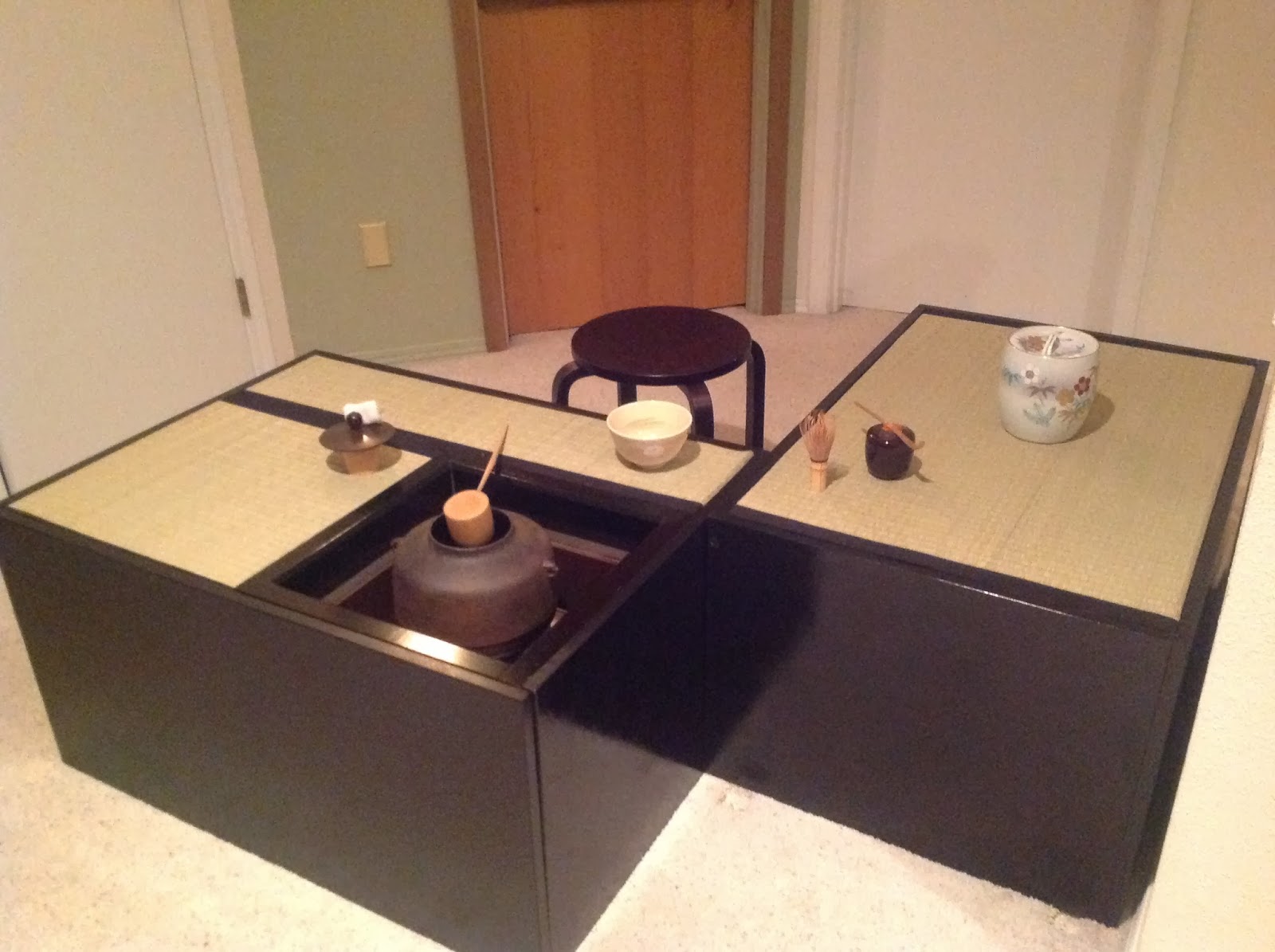
I have a few students who can no longer sit seiza on tatami.  Some of them are sad because there are only a few table style temae you can do.  And there is no difference in the seasons for table style.  So I had a plan for them.

In Portland, we have been rather snowed in for the last three days.  That means that Mr. Sweetpersimmon has been in the shop and I have been at the sewing machine.  Look what we completed this week.  I asked my husband to build me a tatami table so that my students who cannot kneel can sit and make tea on stools.  From photos and diagrams he designed and built not only a tatami table, but a table that can fit a sunken ro.  He also designed the two tables to be portable.  They fold up into two boxes.  Not only that, he made the right hand table so that it can be changed out for the furo season. This means that we can do any temae on this table.  Which is good, because he will soon close the tea room for phase 2 of the renovations, and we can still have class on the tatami table.

Portable elevated tatami with sunken ro


Feb 7, 2014

Beginner's heart

One line of the kotoba reads: As we diligently learn the Way, we shall not forget the humble but eager heart of the beginner.  To many of us who have been studying the Way of tea for a number of years, it is easy to forget what it is like to be a beginner. It is easy to get jaded and consider that today, I will be doing just old hirademae.  I have done this dozens (or hundreds) of times and just go through the motions.  We forget what it is like to be a beginner.

I have a new class of beginners and they are eager and excited to come to class.  Nearly everything is new to them and somewhat intimidating. But their concentration is fierce.  They are paying attention to which foot is entering and leaving the tea room.  They are counting the number of weaves to sit in the proper place.  They listen hard when I am explaining something for the first time. They want to know the proper way to turn the bowl or which way their fan should be pointing. They are hungry for learning just about anything and everything. No matter how often I teach the beginner class, it is humbling to me that there is such enthusiasm for the Way of tea. 

When you are a beginning student, no job is beneath you.  Everything is important and you want to it properly.  Preparing your bowl to make tea is an important job.  Washing up and emptying the natsume is also an important job. For us experienced students, it is good to remember how eager we were to be included in planning a chakai, and even humble things like washing bowls, wiping tatami, and emptying the trash were important jobs.

This is why I like the gyakugatte temae.  It makes me feel like a beginner again. I have to concentrate on my footwork.  The utensils must be placed in different places and I have to remember the order and which hand goes where.  My heart beats fast, I make many mistakes, and it humbles me.  And yet, it brings back my eagerness for the Way of tea; to get it right and make the best tea I can for my guest.

Dec 18, 2013

More reading

In these dark days, it is always good to have a few books to curl up with to take us away.   Here are two more books that I have added to my bookshelf:

Japan and the Culture of the Four Seasons, Nature, Literature and the Arts, by Haruo Shirane. ISBN: 978-0-231-15281-5
I heard a lecture by Professor Shirane at the Portland Japanese Garden this fall.  Here is the publisher's description:

Elegant representations of nature and the four seasons populate a wide range of Japanese genres and media—from poetry and screen painting to tea ceremonies, flower arrangements, and annual observances. In Japan and the Culture of the Four Seasons, Haruo Shirane shows how, when, and why this practice developed and explicates the richly encoded social, religious, and political meanings of this imagery.

Refuting the belief that this tradition reflects Japan’s agrarian origins and supposedly mild climate, Shirane traces the establishment of seasonal topics to the poetry composed by the urban nobility in the eighth century. After becoming highly codified and influencing visual arts in the tenth and eleventh centuries, the seasonal topics and their cultural associations evolved and spread to other genres, eventually settling in the popular culture of the early modern period. Contrasted with the elegant images of nature derived from court poetry was the agrarian view of nature based on rural life. The two landscapes began to intersect in the medieval period, creating a complex, layered web of competing associations. Shirane discusses a wide array of representations of nature and the four seasons in many genres, originating in both the urban and rural perspective: textual (poetry, chronicles, tales), cultivated (gardens, flower arrangement), material (kimonos, screens), performative (noh, festivals), and gastronomic (tea ceremony, food rituals). He reveals how this kind of “secondary nature,” which flourished in Japan's urban architecture and gardens, fostered and idealized a sense of harmony with the natural world just at the moment it was disappearing.

Illuminating the deeper meaning behind Japanese aesthetics and artifacts, Shirane clarifies the use of natural images and seasonal topics and the changes in their cultural associations and function across history, genre, and community over more than a millennium. In this fascinating book, the four seasons are revealed to be as much a cultural construction as a reflection of the physical world.

The other book I am reading is Elements of Japanese Design, by Boye Lafayette De Mente. ISBN:9780804837491
Here is the publisher's description:

 Elements of Japanese Design introduces 80 key concepts in Japanese design in a readable and accessible short-entry format. Including a brief explanation and examples of every aspect of Japanese design-from Wah (Harmony) to Kaizen (Continuous Improvement), from Mushin (the Empty Mind) to Mujo (Incompleteness).

My review:  This is an excellent little book that talks about hard to explain aesthetic concepts.  They all apply to the study of Chado.  What is particularly nice is that each chapter (concept) begins with the kanji, the romanji, and phonetic pronunciation, and then a short description to help you remember the concept.  The further description helps to put these concepts into a western context to help us better understand it.  Easy to read and understand English language helps to bridge the gap in those unexplainable concepts like wabi, sabi, and shibui.

Dec 10, 2013

One Taste of Truth

I am not a student of Zen, but I am a student of tea, so anything in English that helps me understand the relationship of Zen to tea captures my interest.   One of the overt examples of Zen in the tea room is the scroll displayed in the tokonoma.  It is often a Zen saying. Although it may seem on the surface to be a simple statement "nichi, nichi kore kojitsu"  everyday is a good day, or everyday is a day to be liked,  it can have deeper and more profound meanings.

I recently came across the book, "The One Taste of  Truth, Zen and the Art of Drinking Tea," by William Scott Wilson.
ISBN: 978-1-61180-026-5 paperback.
Here is the publisher's description:  Traditionally in China and Japan, drinking a cup of tea was an opportunity for contemplation, meditation, and an elevation of mind and spirit. Here, renowned translator William Scott Wilson distills what is singular and precious about this traditional tea culture, and he explores the fascinating connection between Zen and tea drinking. He unpacks the most common phrases from Zen and Chinese philosophy—usually found in Asia printed on hanging scrolls in tea rooms, restaurant alcoves, family rooms, and martial arts dojos—that have traditionally served as points of contemplation to encourage the appropriate atmosphere for drinking tea or silent meditation.

Part history, part philosophy, part inspirational guide, The One Taste of Truth will connect you to the distinctive pleasure of sipping tea and allowing it to transport your mind and thoughts. This beautifully written book will appeal to tea lovers and anyone interested in tea culture, Chinese philosophy, and Zen. 

What I especially appreciate about this book is that is shows the phrase in calligraphy so we may begin to learn to recognize it. The book also shows the romanji, so we know how to pronounce it, and the English translation.  The explanation that follows for each phrase is easy to follow, and contains more gems for those of us looking for gomei from these phrases.  Historical and cultural context are also covered.   An overall good addition to your Chado library.

Oct 4, 2012

Sensei Says

The student says, "I am very discouraged about my tea study.  What should I do?"

Sensei says, "Encourage others."

Sep 30, 2012

Movement within the tea room


One of the things Machida Gyotei sensei taught us about movement within the tea room is that when you are wearing kimono, only your feet are showing, so you want to make sure that you are walking, turning, sitting and standing in a way that doesn't look awkward and call additional attention to your feet.  Here are some of the points he emphasized:

  1. Walk in the center of the tatami
  2. Don't drag your feet, but lightly skim the tatami to make a slight swish when you walk
  3. You should walk in the tea room as if you were trying not to kick up dust
  4. When sitting down, make sure your toes and heels are together
  5. Likewise when you are standing up, make sure your heels are together so people behind you can't see all the way up your kimono.
  6. Stand up as if a string was pulling on your head straight up
  7. When turning from the temaeza, move your heel back at 45 degrees but don't separate your feet too much
  8. Sit in front of your guest to serve sweets
  9. Move slightly to the side before standing up in front of someone.  Slide straight back with one foot before turning away

One of the reasons we don't step on the black lines separating tatami mats is because in olden times, tatami did not cover the entire floor.  Only nobles sat on tatami.  So there was a change in elevation between the tatami and floor.  If you stepped on the black line, your foot would be partly on tatami and partly on the floor, very awkward.

Most of the movement within the tea room makes sense, and as Machida Gyotei sensei says, "try your best to follow these guidelines, but it won't be the end of the world if you miss something."  


Sep 24, 2012

Confessions of a Chado geek

It has been more than a week since we had an intensive workshop here in Portland with Machida Gyotei sensei and we are grateful to Urasenke and Oiemoto for sending him to Portland.   I don't remember the last time we had a Gyotei sensei in Portland, but I have studied with them while I was in Kyoto, Japan and Seattle.

It always takes me awhile to process what was presented because it is like drinking from a firehose, there is so much information presented in such a short time.

As always we start the seminar with warigeiko, back to basics of folding the fukusa.  Though each time we do it, I learn something new.  Machida Gyotei sensei teaches in a little different manner than others I have studied with.   He asks questions designed to make you think deeply about what you are doing.  For example, he asked us the first day, "Why to you fold the fukusa in this manner to purify utensils?   Did you know that the fukusa is not exactly square?  Why to you think that is?

We studied from the very basic usucha procedures to the most advanced daisu  procedures in the course of three very full days.   On the third day in the afternoon, we practiced kagetsu, including two that I have not done before ko-tsuki kagetsu, and yojohan kagetsu (kagetsu in the four and a half mat room).

Machida Gyotei-sensei  offered practical advice in his lecture, Movement within the tea room, and got into some very philosophical aspects of Buddhist and Chinese daisu procedures, how to handle precious utensils and things to think about for later.  All with a charming and funny demeanor.

It was overwhelming and inspirational at at the same time.   And yes, I really needed that hot tub after sitting on my knees for three days.

Aug 11, 2012

The ash is important to the charcoal

This summer we have been fortunate to be able to burn charcoal and do sumidemae.  We can't make tea if the charcoal doesn't boil the water.  For some reason, the water boiled with charcoal tastes better, sounds better and the steam is more consistently fluffy and pretty.

Of course, it all begins with the haigata or ash form. The first time I saw the ash form, I thought it was some kind of cardboard, and I stuck my finger in the front of it and spoiled the look of it. Making the haigata takes patience and practice. 

When I was at Midorikai we got to burn sumi everyday, and that means one of the chores after dinner was to do the haigata for the next day.  Fortunately for me, I like to do it, and my fellow students didn't, so I did many ash forms during the furo season as I could.  When we switched to the ro season, I bought a furo, ash, gotoku and practiced  in my room just about every night.

I think we got one lesson on ash forms and the rest of the year we were left to discover for ourselves how to do it by practice and experience. Sometimes one of the teachers would come up to the mizuya after dinner and drop the haisaji (ash spooon) in the middle of the haigata.   If the spoon stood upright in the ash, it was too hard packed and the fire couldn't breathe.  If the spoon fell over in the ash, it was soft enough for the fire to burn.  Of course, either way, you had to do it over again.

A few things I learned about doing haigata: 
  1. Don't spend more than 45 minutes playing with the ash.  The more you work it, the more it gets packed down.  Torigai-sensei used to say, "Better an ugly haigata that breathes, than a beautiful one that is too packed down."
  2. There are three main tools to form the ash. The wide flat tool, the curved tool and the spear point tool. I use the wide flat tool for maybe 75-80%  of the time.
  3. Let the ash tool do most of the work.  You really are not pushing down on the ash spoon to smooth it out.  Just lay the tool down gently on the ash and drag it across the surface of the ash.  You will get a beautiful smooth surface without it getting too packed down.
  4. I usually start smoothing the front, then the back then the U shaped valley in the center.  Make sure the valley is deep enough to accommodate the height of the charcoal, plus the width of the kudazumi and edazumi so it won't get crushed when you put the kettle on the gotoku.
  5. Sometimes the angle of what you want to do is very awkward.  Learn to use your left hand to work the right side of the form.   You may have to re-grip the tool in  a different place to get the angle you want.
  6. The only place that is okay to pack down the ash is right behind the maegawara (front tile).  This helps hold the mae gawara in place.
  7. Pay special attention to the corners and the points of the mountains.   It takes practice to make these smooth and sharp.
  8. Smoothing and cutting around the gotoku and maegawara are the trickiest.  The mountain in the front should look like there is no interruption in the line and it looks like it goes right through the gotoku.

If you get a chance to work the ash, it becomes very meditative and sometimes addicting.  Relax and it will show in the final product.  Good luck.


Jun 27, 2012

Meibutsugire part 4 Kanto

Fabrics with stripes, plaid or checked patterns are called kanto. There are different reasons why fabrics with certain patterns can be considered kanto fabrics, and no clear rules exist for classifying them.

In the 16th centry, when kanto fabrics were introduced into Japan, the striped and checked patterns felt new and fresh to chajin (Tea practitioners). From that time on, they were used for making pouches for chaire (thick tea container), considerably earlier than donsu and kinran. Even after donsu and kinran became highly valued, the use of kanto fabrics did not decline because they provided a new range of fabric colors.

Here are a few examples:

Aoki kanto
 The name of this fabric comes from its original owner, Aoki, who was Toyotomi Hideyoshi shogun's retainer.

Kapitan kanto

Kapitan kanto with large stripes

Mumei kanto
Sushuji kanto
Tosai Kanto (10 colors)


Nikuzushi kanto
Nikuzushi kanto close up


All three above: Sagara kanto

Yoshino kanto
 It is said that Lady Yoshino favoured this pattern for her Uchikake, a coat dress. She was a wife of Haiya Jyoeki, a rich merchant who lived in Kyoto in 17th century.
Yoshino kanto
My sensei had a beloved bunrin chaire with a shifuku made of this kereji in these exact colors.  We used it for many years until she passed away.  We don't know what happened to the chaire, but it remains one of my favorite fabrics.


*Fabric photos courtesy of  Kitamura Tokusai Fukusaten Co., Ltd., Kyoto, Japan.via the now closed website Tea Hyakka..


Jun 23, 2012

Meibutsugire part 3 - Donsu

Donsu , a damask satin. like kinran, comes in a great variety of patterns. It is a thick, lustrous fabric made of silk. It is not as dazzling as kinran, but rather has a quiet kind of beauty. The design is integrated into the ground and does not protrude from the surface of the cloth, as in other brocades.

The pre-dyed warp and weft threads are woven where one side of the cloth is warp faced and the other is weft faced and a design is made by reversing the face in the pattern areas.  Not all the meibutsugire fabrics caterogized as donsu have this weave structure. Some exceptions are woven with a twill ground. Since it is finely woven with strongly twisted dyed threads, the overall feel of the fabric is soft.. Chajin especially loved the quiet patterns and pliability of donsu, and for this reason, many chaire pouches have been made with it.

Some examples:

Ariso donsu

Ariso donsu is an image of fish in the waves.  You can also see this motif in the ariso tana and on other tea utensils.


All of the examples above are called Iyosudare donsu.  The name comes from the rred blinds caled iyo sudare.  The design usually consists of stripes with various treasures against a checkeboard ground, or plum blossoms.  The original fabric had both treasures and blossoms in one continuous fabric, but you can see both designs separately.  This fabric was made into a shifuku for the chuko meibutsu chaire called "Sokushiki"

Hosokawa donsu

Hosokawa donsu was owned by Hosokawa Sansai (1564-1645) who was one of Rikyu's seven students.

Soami donsu
 Soami served the shogun Yoshimasa Ashikaga in the Higashiyama period (1435 –1490) as a sort of curator (dobushu) of Yoshimasa's collections.


Kamakura donsu

 
Rikyu-bai donsu
The name Rikyu-bai donsu actually comes from the similarity of the plum blossom motif with the flower known as Rikyū-bai.  This cloth was used by an Edo period tea master to make a shifuku for a black chū-natsume [lacquered tea-container] which bears Rikyū’s signature in red lacquer on the inside of the lid; as a result this cloth is commonly, but mistakenly, understood to have been favored by Rikyū (forgetting that Rikyū died in 1592, while the Ching Dynasty was not founded until 1616).  The cloth itself, a similar textile (featuring a plum-blossom motif in ocher on a dark-blue background) is occasionally encountered under the name Riky-bai donsu. The true Rikyū-bai donsu has a plum-blossom motif which fits into an oblong diamond (though this is not so obvious at a glance, since the design has five points rather than four), while the other (which is actually based upon the ori-dome, or woven-on cover, of the striped Iyo-sudare donsu (see above)has a plum-blossom which fits into a circle (thus it is shaped like a regular 5-pointed star).

Oribe donsu

Oribe donsu is said to be in the taste of Furuta Oribe, a disciple of Rikyu.  On a deep, quiet blue ground, the light yellow-green waves stand out, with plum blossoms floating on them.  Oribe was very fond of plum blossoms as he used that motif in his designs for ceramics and other fabrics.

Sokun donsu
 This example of a geometric pattern is sometimes known as shippo tsunage, or interlocking seven treasures.  The treasure elements appear in varied form on a blue background in the center of the circle with plum blossoms. The name of this fabric comes from its original owner, Imai Sokun. Sokun, son of Imai Sogyu, was a tea master in the end of the 16th century begining of the 17th century.

Sumiyoshi donsu
Sumiyoshi donsu is a geometric triangular design.  It was used as a pouch for a thick tea caddy called "Sumiyoshi Bunrin" Chaire.

Mozuya donsu
It is said that Mozuya Soan, who was a merchant in Sakai, Osaka and Sen Rikyu's daughter's husband, possesed this fabric.

Sasazuru donsu
 Designed with the auspicious pine-bamboo-plum motif  (shochikubai) symbols of long-life, nobility and hope). Sasazuru donsu has many different variations.


*Fabric photos courtesy of  Kitamura Tokusai Fukusaten Co., Ltd., Kyoto, Japan.via the now closed website Tea Hyakka..


Jun 16, 2012

Meibutsugire part 2 Kinran


Kinran(gold brocade) is considered the most gorgeous of the meibutsu-gire. The first syllable of the word, kin, means "gold". the second, ran, refers to cloth that was attached to the hem of a Buddhist cloak to strengthen it.  Kinran has a ground wave of twill and weft patterns woven with either gold thread or threadlike strips of gilded paper.  Kinran was first made in China (known as Zhijin) during the Song Dynasty. It came to Japan through Sino- Japanese trade at the end of the Fujiwara and Kamakura periods, in form of ceremonial robes for Zen monks. Kinran began to be made in Japan during the Momoyama period. 

Below are some of the more well know kinran fabrics and patterns:


Futari Shizuka Kinran

The name of this fabric comes from a Noh play called Futari Shizuka. It is said that Ashikaga Yoshimasa shogun (1436-1490) performed this particular play wearing a costume made of Futari Shizuka Kinran fabric. Late Sung period - early Ming period. 

Daito Kinran
Daito kinran has a design of auspicious clouds.  Daito kinran is popularly believed to be the fabric used in the surplice of Daito Kokushi, the founder of Daitokuji (temple) in Kyoto, Sung period.


Osaka Kinran
Osaka kinran is named after the shifuku used with the Osaka Marutsubo chaire, from the Ming period.


Wakuda-de Kinran
Wakuda kinran has a design of waterfowl in a lotus pond.  Named for the owner of the fabric, from the Ming dynasty.


Shippo Setsugekka Kinran

Shippo Setsugeka Kinran is a design of interlocking rings, with snowflakes, moon and flowers, favored by the Urasenke14th Generation Grand Tea Master Tantansai.


Hariya Kinran
 Hariya Kinran was named after the shifuku used with the Hariya Katatsuki chaire owned by Hariya Soshum. Also called fish scale pattern.

Itoya Kinran
 Itoya is a design of jeweled wheels on a basket weave background.  It is often woven as a futusu, or double weave fabric where the opposite colors appear on the reverse side.  Where blue appears on one side of the cloth, yellow shows on the other and between them a pocket is created.  Futsu weave is named for "breeze funnel" and derives from the empty space between the two faces of the fabric.  If this were woven with gold thread it is "Itoya futsu kinran."   The fabric name comes from the cloth owned by Itoya Ryotei, who lived in Kyoto in the 16th century.  This fabric was made into a shifuku for the chaire named "Sogo nasu."  This fabric was first made in China, probably, Ming dinasty around 1573-1619.

Hanausagi Kinran


Hanausagi Kinran
Chaji Hanausagi Kinran

Moegiji Hanausagi Kinran

Suminokura Kinran
 The previous five fabrics are variations of a cute rabbit standing on its hind legs looking back at some blossoming trees.  The last one is named Suminokura kinran for the wealthy Kyoto merchant Suminokura Ryoi, who was particularly fond of that kind of design, the difference is that the pattern is bigger than Hanausagi Kinran.

There are many other famously named kinran fabrics, but you can begin to recognize these fabrics in your study when the guests ask about shifuku kereji.

*Fabric photos courtesy of  Kitamura Tokusai Fukusaten Co., Ltd., Kyoto, Japan.via the now closed website Tea Hyakka..