Showing posts with label temae. Show all posts

Mar 30, 2015

5 ways to make your temae go better


  1. Before you enter the tea room, take 5 slow deep breaths.
  2. Trust your body, don't try to out think it.
  3. Look at mistakes as opportunities to  learn.
  4. Don't forget to breathe during your temae.
  5. Remember that making a good bowl of tea is the most important thing.

Oct 29, 2014

Rikyu's futaoki

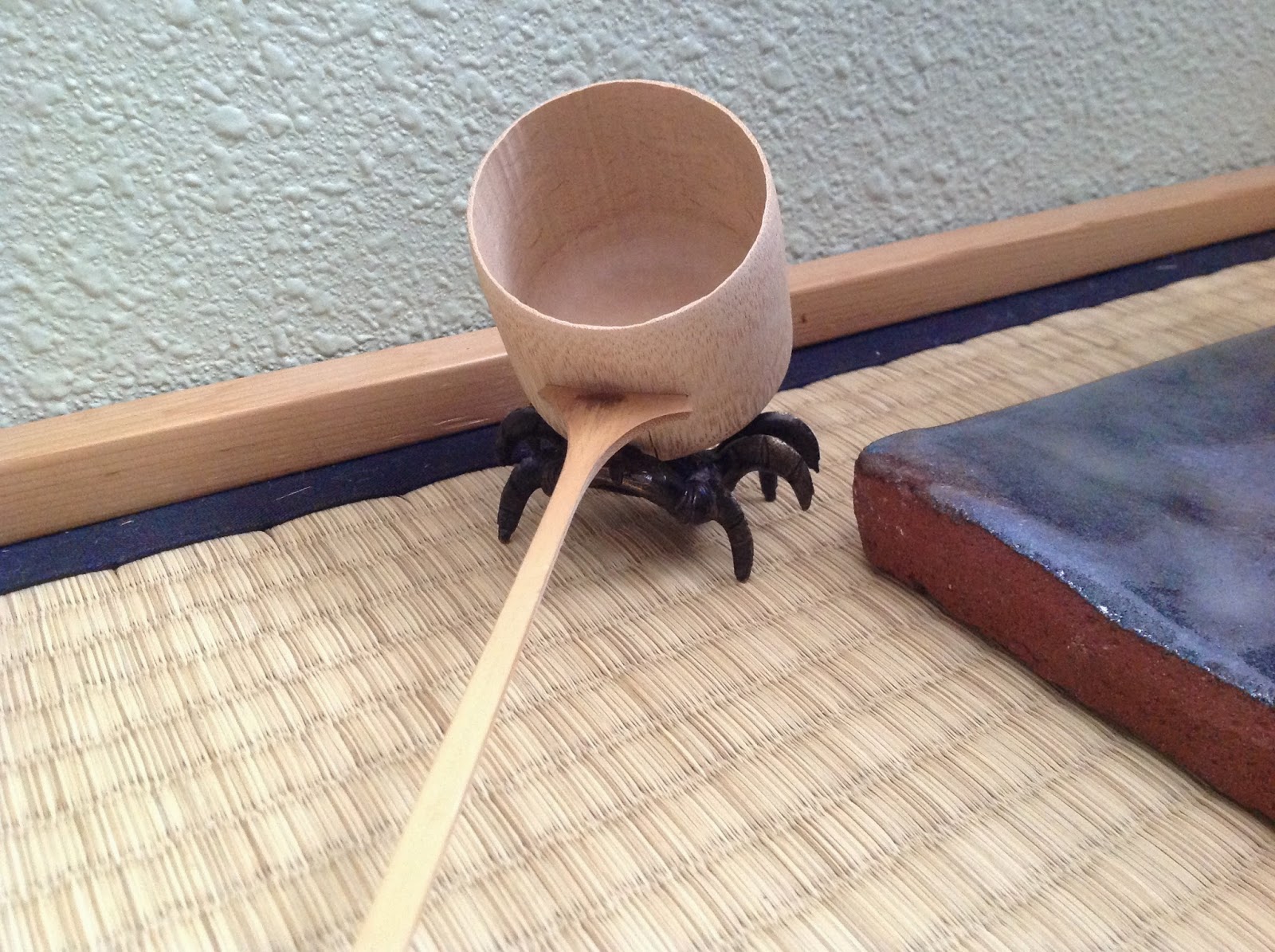
We have been practicing with a variety of dogu this year in the intermediate classes.  I have a bronze set of the 7 futaoki supposedly favored by Rikyu. (Rikyu no nanashu no futaoki).  A futaoki is a kettle lid rest, and also can be used to rest the hishaku.  These are ways to handle and display the futaoki that I have been taught:

Kani futaoki -- crab lid-rest
The design of this lid-rest was adapted from the brush and sumi ink-stick rests of similar shape and size.  This futaoki is most appropriately used in spring and summer months.  The face of the crab determines the front and is used like any other futaoki by placing it on the tatami mat in line with angle of the hishaku.


Sazae futaoki -- turban shell lid-rest
An actual shell was used originally for this lid-rest, but was  replaced by ones made of metal and clay.  The front of the futaoki is determined by placing the pointed casing of the shell towards the fire.  It is placed in the kensui and used during temae with its underside up.  When displaying it on the tana, it is turned from right to left and placed with its underside down.

Hoyakoro futaoki - chalice shaped incense burner lid-rest
The design for this futaoki was borrowed from a lidded incense container used in Buddhist ceremonial rites.  It is used in both the ro and furo seasons when performing daisu or nagaita sokazari temae (the full display of utensils on the long board).  It is most frequently made of metal in either a five or six pointed cup design.  To determine the front, count the number of points and place one point in front if the number is odd, or two points front if the number is even.  The if this futaoki is closed when it is in the kensui, displayed the daisu or nagaita.  When it sis used it is handled like an old Japanese book -- opened from left to right and closed from right to left.  During koicha temae, the lid-rest is closed when it is not being used to support the kettle lid or hishaku.

Ikkanjin futaoki -- idle person lid-rest
This lid-rest is placed face forward, right side up in the kensui and on the tana and on its side when it is being used to support the lid and hishaku.  The boy at the well is thought of as idle, because he relaxes when he works and works when he rests.  Tu use this futaoki, pick up the hishaku with the left hand, removed the futaoki from the kensui with the right hand.  Replace the hishaku on the kensui, steady the futaoki on the left palm, turn on its side so that the boy's head will face the direction of the fire after it has been placed on the tatami.   Just the opposite of holding his feet to the fire.

 Mistuningyo futaoki -- three Chinese dolls lid-rest
The mitsuningyo futaoki probably pre-dates Rikyu as Chinese celedon examples have been found in Japanese collections.  This lid-rest may be used year-round. The doll dressed differently from the others is placed to the front.

Mitsuba futaoki -- trefoil lid-rest
This lid-rest resembles the edible trefoil plant and is used in the spring and summer months.  In the kensui and during temae, it is placed with the larger side up, with one single leaf to the far side.  To display it on the tana, it is turned over from right to left so that the larger side is down.

Gotoku futaoki -- (five virtues) trivet lid-rest
The gotoku futaoki is also called kakureiga (retreat) because the base is hidden in the ash.  It is used in the ro and furo seasons when the kettle is suspended (tsurigama), or rested on blocks (sukigigama), or directly on the brazier (kirikake buro).  It is placed in the kensui and used during temae with the circle side up and one leg to the far side.  At the end of the temae, it is turned over, right to left, and displayed with the circle down.

This is a good reference for the Rikyu no nanashu no futaoki, and I hope you all have a chance to use them in the future. 

Dec 28, 2012

Winter intensive

The day after Christmas, December 26th we had our first Winter intensive at Issoan Tea School.  For my students it was their first intensive.  We started at 3 pm and ended at 9:30 pm.  In between we sat zazen, practiced warigeiko, reviewed movement in the tearoom,  did five teamae, laid the charcoal shozumi and rebuilt the charcoal fire gozumi.  One student brought a sushi platter and I made ankake udon for everyone.  It was such a success, that we plan to make it an annual event.

Shozumi and Gozumi, laying the initial fire and reubuilding the fire were particular highlights.  We don't often get to do these procedures, and especially gozumi so it was a special treat.  The charcoal is kind of like your timing device to keep your tea gathering on track. The charcoal is made from special wood and cut into specific size and shape to burn for a specified length of time.   It is amazing to hear the singing of the kettle suddenly go silent (and it does seem to be sudden) all at once.  It is also a clue to the guests that it is time to take their leave.

Of the two, gozumi is more difficult because you never know what the fire is going to look like as it burns down.  Many factors contribute to how the fire burns, from the haigata (ash form), to how the initial fire was laid, to shape of the kettle, how big the furo, how deep the ro,  to how long the fire has burned. 

So as a host, the first thing you do when you remove the kettle replenish it is to observe how the fire has burned.  How much charcoal is left?  Did the center collapse?  How much of the dozumi (large front charcoal) has burned?  Then you rearrange the coals to make room for fresh charcoal and lay them in the fire.  You have to use your own judgement whether to use all the charcoal in the basket or only use part of them.

It was a nice fire the students built.  And within 30 seconds of returning the kettle to the fire, we once again heard the matsukaze, the sound of the wind in the pines and the murmuring of the kettle.

Dec 19, 2012

The differences are the same

I had the privilege of attending an Omotesenke chakai this last weekend.  Even though I have participated in chakai in Japan, it was very educational to be able to see it again in a much more intimate setting.  

I get asked all the time about the differences between Omotesenke and Urasenke.  I usually respond that I don't study Omotesenke, so I cannot really compare and contrast the pros and cons of each. But I'd like to offer a few observances from the perspective of being a guest.

Our host is an experienced tea sensei from Japan.  In fact, she is a third generation tea teacher. She prepared the chakai for us, knowing that most if not all the guests were from the Urasenke tradition.

What surprised me, when it really shouldn't have, was how similar the chakai was to Urasenke style.  After all, the history is the same, the aesthetics are the same, it's connection to Zen is the same. the utensils are the same, and the order of the temae is the same. I felt very comfortable attending the chakai because most of it is the same as a typical Urasenke chakai: The tokonoma display is the same, the sweets are the same, nearly all the utensils are the same, and the order of the temae is the same. In fact, if I were just coming to Chanoyu for the first time, I think I would be unable to distinguish a difference in the two schools.

But because I was observing very closely and paying attention there are a few small differences. One is that the sweets were served in a covered dish.  Another difference is  that the inspecting and preparing the whisk is not as vigorous and the whisk was made of smoked bamboo, rather than the white bamboo we use. One other thing that tickled me was the beginning of folding the fukusa.  It was opened with a snap and then folded in a very similar manner that we use. The final thing I noticed was that the tea was not completely foamy on the top, though it was thoroughly mixed and was really delicious. 

Though there have been some misconceptions about the differences in the tea schools, to me, it really doesn't matter what school of tea you study. Some say that one or the other school likes to show off expensive utensils, or that the way they whisk the tea is because they use inexpensive tea.  Some people say that there is a big rivalry between Urasenke and Omotesenke, but I have not had that experience.  In Kyoto they invite each other to chakai. The headquarters for the schools are right next door and they are related.  In our chakai, we all got along very well with not hints whatsoever about rivalry.  It was another experience of sharing a bowl of tea and everyone thinking of each other.

What school of tea should you study? Find a teacher that you can study with for a long time who is willing to teach you and study the school that they teach.

Sep 24, 2012

Confessions of a Chado geek

It has been more than a week since we had an intensive workshop here in Portland with Machida Gyotei sensei and we are grateful to Urasenke and Oiemoto for sending him to Portland.   I don't remember the last time we had a Gyotei sensei in Portland, but I have studied with them while I was in Kyoto, Japan and Seattle.

It always takes me awhile to process what was presented because it is like drinking from a firehose, there is so much information presented in such a short time.

As always we start the seminar with warigeiko, back to basics of folding the fukusa.  Though each time we do it, I learn something new.  Machida Gyotei sensei teaches in a little different manner than others I have studied with.   He asks questions designed to make you think deeply about what you are doing.  For example, he asked us the first day, "Why to you fold the fukusa in this manner to purify utensils?   Did you know that the fukusa is not exactly square?  Why to you think that is?

We studied from the very basic usucha procedures to the most advanced daisu  procedures in the course of three very full days.   On the third day in the afternoon, we practiced kagetsu, including two that I have not done before ko-tsuki kagetsu, and yojohan kagetsu (kagetsu in the four and a half mat room).

Machida Gyotei-sensei  offered practical advice in his lecture, Movement within the tea room, and got into some very philosophical aspects of Buddhist and Chinese daisu procedures, how to handle precious utensils and things to think about for later.  All with a charming and funny demeanor.

It was overwhelming and inspirational at at the same time.   And yes, I really needed that hot tub after sitting on my knees for three days.

Jun 23, 2010

Inner and outer aspects of the fukusa

I wrote earlier about the care and feeding of your fukusa,  and as part two, I'd like to talk more about your fukusa.

During the preparation of tea, the fukusa is folded in various ways to purify utensils in front of the guests.  I know of about 20 different ways to fold it.  What you are doing is exposing different surfaces of the cloth to purify the different utensils.  There  are three categories of folds:  shin (formal) gyo (semi-formal) and so (informal).

In the formal tea ceremony, koicha, one of the first movements is the formal inspection of the fukusa (yoho sabaki) before purifying the chaire.  It is the clockwise movement used to examine the four sides of the fukusa.  As with all parts of the temae there is additional meanings to the movements.

Inner aspects of the fukusa:  Unlike usucha, koicha requires four meditative breathing pauses when folding the fukusa.  This emphasizes the formality of koicha and the host and guest begin to breathe in unison.  This is not to be hurried through.  With each part of this movement there is a pause -- a breath and then movement, pause -- breath, movement until all four sides have been completed.  The traditional meaning behind this action is the inner reflections that strengthen our character and is a directive for our lives.  With daily examination of these inner aspects it will bring growth.

When the fukusa is open and in position centered over our left knee the first reflection is
Thoughtfulness "zin"  Note here there is a pause but no breath
Then Righteousness "gi"
Thankfulness "rei"
Wisdom "chi"
Truth "shin"

Outer aspects of the fukusa: With the influx of modern life into the world of Chado, scholars have attempted to broaden the philosophy and understanding of Chado.  Now reflections that are taught for this movement not only involve the inner aspects mentioned above, but also intertwine with more tangible ideas:

The first reflection is:
Heaven (above)  note there is a pause but no breath
Parents (East)
Teachers (South)
Family (West)
Tea community (North)

The final movement is returning the fukusa to the center and forming a triangle with the thought of Earth (below).  These concepts may be easier for the modern mind to accept because they are ideas we live with daily.  These interpretations deal with the sharing aspect of tea rather than emphasis on inner progression.  It is the blending of these two aspects the inner understanding and outward sharing that koicha is prepared and received.

Apr 26, 2010

The right way

"One learns by looking and studying.  Without understanding completely, one cannot criticize."  ~ from the 100 poems of Rikyu


We just had an intensive workshop here in Portland with Christy-sensei.  It is always inspiring and somewhat intimidating.   The format is one after another, students make tea for sensei and we often go from the very beginning procedures to the very highest in the space of about 3 days.  Or maybe in the reverse order, depending on the schedule. We all were studying our notes before she arrived, and sitting seiza at night watching TV to build up our strength for those 12 hour days sitting seiza.

We always have warigeiko, that is, back to the basics of folding the fukusa and purifying the utensils.  I always learn so much from this, even though I have been doing tea for many years.  Christy said that when the Gyotei came to San Francisco and he was teaching warigeiko, all he did was talk about posture.  Those finer points, points I knew and have forgotten, or have gotten sloppy at wore gone over and I retrained my body again.  Christy is so very good at giving honest feedback on form. That is also why tea cannot be learned from a book or by yourself with videos.   You need a teacher who can look at you and correct your form, placement, posture, and speed.  You need a teacher who will tell you to stop and take a breath.   A teacher will also tell you straighten your back or keep your focus on your non-working hand.

When I was in Japan, some teachers didn't teach as actively as teachers here in America.  One only watched you as you went through your temae and said not a word.  If you forgot or got lost, he just looked at you and it was up to you to struggle through to the end.  Another one would tell me that I was not doing it right, but did not tell me how to correct it, I had to figure it out. Boy those were some hard lessons, and yes, I do remember them much more vividly than if the teacher had just prompted and corrected me at the time.

I had a teacher who once said that the presence of the teacher is more important than the teaching itself. If  a student really wanted to learn the way of tea, they had to steal the knowledge.  By watching and paying attention was how one learned.

In America, sometimes students will question the teacher, especially if they have had other teachers in how to do a procedure. (or more recently saw something on video or Youtube)  My sempai taught me (rather severely) that whoever is teaching at the time is the right way to do it.   I have note books with notations (Christy sensei teaches this way, but Minako sensei teaches this way).  Even if the same teacher teaches something a little differently at a different time, it is still correct at the time the sensei is teaching.  

This is very hard for some people to grasp.  If there is a right way to do it, they want to know it and they want to know it will always be consistently right.   In Chado there is a right way to do things and we must learn it.  But there will always be some ambiguity in oral teaching and we must make the best of it as we can.  When we have the experience and understanding to judge, we can decide what is right for us.  Until then, the sensei teaching at the time is always right.   Just say "hai."

Sep 25, 2009

Thoughts on gomei, or poetic names

Students who practice Chanoyu are asked by their teachers to think of gomei or poetic names for tea utensils. Many students think it is a chore or silly to come up with names for your chashaku every week. But during the haiken, or the appreciation part of the ceremony, the gomei can heighten the drama, tell the story of the utensil or enhance the theme of the tea gathering.

Gomei, literally, most honoured name, are given to utensils, sweets, and other things related to Tea. Originally, names were given to various objects by great connoisseurs and Tea masters in the late Higashiyama period. Kobori Enshu gave many famous tea utensils gomei taken from poetry and literature.

Tea utensils may reflect nature by echoing particular seasons both in form and with their poetic names. In observing the seasons, there are many more than the basic 4: spring, summer, fall, and winter. For example, early spring is more like winter and late spring is more like summer. Flowers are a great indication of the season as they don't appear at once, but can evoke the time of year that they bloom. So noticing what particular flowers are in bloom are a good source of gomei. Also instead of just naming a flower, a good gomei may offer a description of the flower. For example, Kiku or chrysanthemum is a good autumn flower, but to use kiku as a gomei is a little general and not very poetic. If it is late November, the chrysanthemums are getting a little tired as their blooming season is coming to an end. So "rangiku" or ragged chrysanthemum might be a gomei for that season.

Gomei can also come from place names that evoke different feelings, seasons or memories. For example, the gomei "Tatsuta" refers to the Tatsuta river in Nara prefecture. In the fall this river fills with fallen red maple leaves and thus alludes to the momiji or red maple leaves of autmn. Likewise, Yoshino is a place where the hill sides bloom with cherry blossoms in the spring. With these place names, one can allude to the seasons without directly saying "cherry blossoms." It gives a little more sophisticaton, depth and feeling to the name.

For usucha and okashi (sweets) gomei can be very seasonal and light; sometimes they can be humorous, or emotional such as "chajo chashin" tea feeling, tea heart. When we get to koicha, however, the gomei are a little more serious. Many Zen words and phrases are used as gomei. For example, I have a scroll with a Zen phrase that says: White clouds come and go as they please. I might pair this scroll with a tea scoop name "Ao yama" or green mountain because the companion phrase to this is: Green mountain is unmovable.

Japanese literature is also a rich source of gomei. An example of this might be "Murasame" literally it means autumn rain. Murasame was also one of two sisters in the in the Noh play Matsukaze. The two main characters are the sisters Matsukaze and Murasame who once lived on the Bay of Suma in Settsu Province where they ladled brine in order to make salt. A Middle Counsellor named Yukihira dallied with them while staying at Suma for three years. Shortly after his departure, word of his death came and they died of grief. They linger on as spirits or ghosts, attached to the mortal world by their sinful emotional attachment to mortal desires. The name of the chief character, and title of the play, Matsukaze, bears a poetic double meaning. Though Matsu can mean "pine tree" (松), it can also mean "to wait" or "to pine" (待つ). Autumn Rain is strong and gentle intermittently, while the Wind in the Pines is soft and constant. Though the characters in the play actually represent the opposite traits - Matsukaze alternating between strong emotional outburts and gentle quietness while her sister remains largely in the background, and acts as a mediating influence upon Matsukaze. Many layers of meaning here: Autumn, love, tears, grief, desire, strong, gentle depending on how it is used.

So please think about your gomei for keiko next week and use your imagination and some of these suggestions. It will make your temae more interesting to both your teacher and your guests.

Jul 16, 2009

Performance Anxiety

Doing temae in class is sometimes intimidating, especially when we are learning a new procedure. We want to get it right from the very beginning. Many students have performance anxiety and can do procedures at home but make mistakes or forget the order in front of sensei.

I used to get very nervous before class and worried if I was going to forget something. But after many years of class, and some very kind (but strict) sensei, I have come to the conclusion that performance anxiety is ultimately a self-centered thing. When I should have thought about making the very best tea for my guests, I worried about how I looked. When I should have concentrated on being as natural and relaxed for so my guests enjoyed the experience, I was tense and worried about doing things in the correct order. When I should have made a mistake beautifully, I became embarrassed and forgot what the next thing to do was.

My sensei told me that the classroom is the place to make your mistakes. (And believe me; I have made some real doozies). If you look at mistakes in your temae as learning opportunities, then the outcome is not whether you did it right or wrong, but what did you learn from it. How do you handle a mistake or lapse of memory? Do you get flustered? Do you lose your place? How do you recover from a mistake?

Sometimes we learn more from our mistakes than we do from our successes. Often the lessons we learn in the tea room have nothing to do with the temae and correct procedures. How you are in the tea room ultimately is how you are in life. If you can detach enough to see how you behave in the tea room, many lessons will open up for the rest of your life.

Torigai-sensei in Kyoto was watching me make tea one day, and afterwards, told me, “Marjorie, you will never have a perfect temae.” I was disappointed that after I worked so hard she thought I would never achieve a perfect temae. “However, you are very interesting to watch. You are able to work yourself out of your mistakes and come out fine in the end.”

Presentation July 18th
Issoan tea will be at the Portland Japanese Garden on Saturday July 18th at 1:00 and 2:00 pm for a demonstration of Chanoyu. Free with admission to the garden. Come down to the tea house for an explanation and to see Japanese Tea Ceremony.

Jun 19, 2009

Just dye your heart with Chanoyu

During the Friends in Tea conference, there were two formally scheduled chakai, the opening chakai the first day and the closing chakai on the last day. In between, there was what they called open chakai. The tatami mat room upstairs at the guest house at Dai Bosatsu was divided in half and people could sign up to make tea, drink tea or help in the mizuya.

Many participants brought tea utensils to be used at these open chakai, and with the sweet making workshops going on, we always had plenty of sweets. Wild flowers were growing in abundance and thanks to Jan, the mizuya cho, tea and everything was available to put on chakai.

You could also put together impromptu chakai outside, in the meeting room, on the terrace or on the dock over the lake. More than a few people brought chabako, and there was always an early morning chakai in the woodshed.

I would say that there were about 10 scheduled chakai a day in the tatami room and at least 2-3 more chakai that you could attend in other places. And still, I couldn't get enough of making and drinking tea.

"Don't look with your eyes or cock your ears to listen, just dye your heart with Chanoyu . Look with your eyes and listen with your ears, smell incense and grasp their meaning with questions." ~ from Rikyu's 100 poems.

*Photo courtesy of Morgan Beard

May 20, 2009

Chakai

I was invited to a chakai Monday night. Mr. Nishiura, owner of Ryokusuido was in town from Tokyo. He is a student of Omotesenke tea school, and we made tea for each other. One thing that he told me about Omotesenke is that there is the way that men make tea and it is different than the way that women make tea. The simpler way is the way that men make tea.

It was a wonderfully sunny, warm day for a chakai, and I arrived at the house in the late afteroon. I love the way that the sidewalk out to the street is dampened all the way out to the street in the summer time in welcome. It looks so fresh and cooling.

Inside the house was cool and dark. Mr. Nishura had prepared a cool drink for me and invited me to enter the tea room. He had cleaned the tea room top to bottom as well as washed the window so that it looked like there was no glass in it.

He brought fresh sweets from Japan and I enjoyed watching him make tea in the men’s Omotesenke style. What struck me was that the temae placement and order were exactly the same as Urasenke style that I study. Just a few stylistic differences made the procedure distinctive, but not strange. Many of the movements were familiar because they were movements that Urasenke style uses for koicha but not usucha. I could see, however, that studying one style and switching to another style can get very confusing.


The tea was fresh and green, and I particularly enjoyed the “jade lake” in the center of the teabowl surrounded by foam. I then prepared and made tea for Mr. Nishiura and as we cleaned up, we compared notes on the different styles. He was very appreciative of the tea I made for him and complimented me on how graceful was my temae. (That was a first for me and quite unexpected).

Apr 28, 2009

Return to the original one again


keiko to wa ichi yori narai ju wo shiri ju yori keru moto no sono ichi

In training for chanoyu, you go from one to ten and return to the original one again.

This is from one of Rikyu’s 100 poems. Next week we will close the ro and begin the summer season for chanoyu. Before we begin the furo season, all the classes will review the basics again. We will learn how to walk in the tea room, how and when to bow. We will review folding the fukusa and purify the tea utensils and correct bad habits that we have acquired along the way.

When I went to Japan to study tea, even though I had 15 years of tea training, they began teaching us how to walk and bow. The sensei assumed you knew nothing and started everyone at the beginning, no matter how long you had studied. One sensei said that I had accumulated many bad habits and I needed to go back to the beginning. At first I was rather put out by what I thought was wasting time, until I found out that at every koshukai (intensive training workshop), they taught the basics to everyone, even teachers of more than 20 years’ experience. They call this warigeiko.

Even though we go back to the beginning, it really is not the beginning because we have some experience of what it is like to study. I like to think of it as a spiral. Each time you come back to the beginning, you go deeper and learn more about yourself, your temae and your relationships. Just like the seasons come around again, it is different every year. This spring is not like last spring, nor the spring before that.

So next week, bring your fukusa basami, chakin, chasen, chashaku. Be prepared for warigeiko, back to the orginial one again.

Apr 7, 2009

Slow Down

Another lesson I took from the koshukai is that I need to slow down. My mind is always full of thngs, and as Christy sensei told me that an active mind manifests as an active body. I sometimes do things so fast that the guests don’t have time to catch their breath or visually rest when they watch me make tea. Especially with koicha, the pace is slower than with usucha to give the ceremony more weight.

This is not a new problem for me. I know that my mind moves very fast, and I talk very fast. When I get nervous, I move and talk even faster. I am getting better though, Christy sensei did find a few places while I was making tea that were restful, but I really need to slow down.

One way I do this is to pay attention to my breathing. Whenever I am nervous or excited, I tend to hold my breath or breathe very shallowly. Taking one or two deep breaths helps to restore oxygen to my system and my brain seems to function better. Continuing to breathe while my body is moving tends to focus my mind, slow down my nervous tics and allows me to be more present.

From the beginning of entering the tea room until the last act of closing the door, your breathing should be even and controlled. This breathing helps to control the pace of the procedure. As you begin the procedure, folding your fukusa, your guests will begin to breathe in unison with you. It is amazing what happens to the harmony in the room when everyone is breathing in unison.

If you have the opposite problem that I do, of being too slow and too deliberate, increasing the pace of your breathing very slightly will help the pace of your tea procedure. Holding your breath while you make tea does not do you any good at all. You must breathe.

Apr 4, 2009

Breaking bad habits

During the course of making tea for Christy sensei, she pointed out a bad habit I have when I fold my fukusa. I didn't even realize that I was doing it. She stopped me in the middle of folding it and asked me if I knew why she stopped me. I had no idea and she said that it must be a habit if I am unaware of it. She then proceeded to demonstrate what I do and I was appalled at how sloppy it looked. From then on, I was conscious of making sure I did NOT do it when I fold the fukusa.

The first step in breaking a bad habit is becoming aware it is a habit. We cannot see ourselves so it is a good thing to have someone point these bad habits out. The problem is that honest feedback seems so impolite in the tea room. To overcome this, the intention of giving the feedback has to be clean and it must be pointed out in a loving way. I am grateful to sensei that she is paying attention to what I do and is honest with me to help me improve.

We train our bodies so that we can do the movements of temae with an empty mind. And if we train our bodies to do something, it will faithfully reproduce what we have trained it to do; it becomes a habit. Somewhere along the way, I had trained my body into a bad habit and I did it without realizing that I was doing it. They say that it takes a minimum of doing something 32 times before it becomes a habit. So the second step once we become aware is to consciously do it correctly for a minimum of 32 times.

Christy also suggested that I examine what it was that made me initiate the bad habit in the first place. For something as basic as folding the fukusa, I know the correct way to fold it, but something triggered a change and I kept repeating it until I became unaware of it. By examining the trigger, it will help me break the bad habit as I re-train my body to do it again correctly.

Apr 2, 2009

Pay attention to what you are doing

No matter how many times we have done temae, it is always good to pay attention to what we are doing. One of the things Christy sensei emphasized in koshukai is the precision with which we do temae. First of all make sure that the orientation of your body is correct. Especially in the winter season, there is a difference in centering your body with the outside corner of the hearth frame and the inside corner. There may be less than an inch in difference, but it changes the position of all the utensils as you use them. Your left knee should also come up to be even with the corner of the hearth frame, and the space of 16 tatami weaves should be in front of you. Also make sure that your body is centered with the outside line of the hearth frame when speaking with guests and putting out the haiken utensils.

One thing many students become sloppy with is picking up and moving utensils. When the left hand or the right hand picks up or puts down the bowl make sure it is precisely at 9 o’clock or three o’clock on the bowl. There are certain times to pick up the bowl or set it down at 5 o’clock or 7 o’clock. Know when to use these different handling techniques and why. When transferring the bowl or the hishaku (water scoop) make sure that changing hands occurs in the center of the body. A lot of students tend to transfer the utensils from one hand to another on the way to where ever it is traveling.

After purifying natsume or chaire, the fukusa is squeezed in the right hand, but then it comes just over the right knee. If you pull your hand up your leg near your body, you get this chicken wing effect as you put down the tea container that looks awkward and funny.

Finally, make sure you have good posture. Not only do you look better in kimono if you have good posture, but also when making tea, sit with a straight back and not too close to the bowl. Bow with a straight back and do not put your weight on your hands while you are doing it.

We all learned these things as basics, but it is always a good reminder to pay attention to what we are doing in temae, even if we have done them a hundred times before.

Apr 1, 2009

Back to Basics

Christy Bartlett sensei was just in town for koshukai, an intensive teaching workshop for the way of tea. These workshops are always an inspiring and humbling experience. Usually they last two or three days and are divided into sections for advanced intermediate and beginner students. The students prepare and make tea for other student guests much like regular keiko, but as I said before it is intensive. Christy sensei’s experience, knowledge and teaching deepen our understanding of the way of tea, of the historical precedents of tea, of the exact order and questions about temae and most important, something about ourselves. One thing I so appreciate about Christy sensei is that she gives the most honest feedback and corrects even the smallest points to pay attention to. The effects of these workshops stays with me for many days and weeks.

These koshukai are also a gathering time to be with people who we do not ordinarily see, fellow students and teachers of the way of tea. While the format of the classes are strict, there is a fellowship of feeling as we are all there to study hard and learn more. There is something to be said about the closeness one feels for other students who have suffered along with you sitting seiza for 8 hours a day for three days.

It was interesting to me that this time, what struck me the most was not so much the teaching of the upper temae, but comments and teaching from sensei about the basics. How to fold the fukusa, working on footwork, conversation about utensils, picking up and putting things down, the speed (or slowness) of the pace of temae. How we do all of these things tell us about ourselves. It is a way of looking at ourselves as we are in the world. What can we learn by looking at ourselves as we behave in the tea room?

Sep 14, 2008

From the left hand

For students following the way of tea, everything is done right handed. Wiping, purifying, whisking, picking thing up with chopsticks, scooping water or tea, all are done with right hand. How disorienting it must be for left handers.

I have felt some of the disorientation that left handers encounter when I began to learn the gyakugatte procedures. Gyakugatte refers to the orientation of the room and it means ‘the opposite hand.’ In an orthodox or hongatte room, the guests are seated to the right of the host. The host makes tea and sets the teabowl out to the guests with the right hand. In a gyakugatte room, the guests are seated to the left of the host and the teabowl needs to be set out to the guests with the left hand because it is difficult to reach with the right hand.

In a gyakugatte room, the kensui is brought in with the right hand, entering the room is done with the left foot and the fukusa is worn on the right side. Though some things are done with the opposite hand, not all of the procedures are. Purifying utensils are done with right hand, water is still scooped from the kettle with the right hand and tea is whisked with the right hand.

Since I learned to do the gyakugatte procedures after ten years of doing it the orthodox way, my body was trained to anticipate the next move until I rarely had to think about it. The new procedures produced an uncomfortable sensation in my body and I became quite anxious whenever I made tea this way. My footwork was all off and my timing suffered. In fact, I felt like a beginner again because I didn’t know what to do next or which hand to use to pick up or put down anything.

It is quite humbling to feel this way. That is one of the reasons why I sometimes prepare a tea demonstration for gyakugatte. I have to pay strict attention and be very present to get through these procedures in front of people. Thank sensei, for teaching me these procedures so that I won’t forget what it feels like to be a beginner.

Sep 3, 2008

The presence of the teacher

When Christy sensei comes for koshukai, there is so much information that my head spins. She not only teaches us the formal tea procedures, has also lectured on aesthetics, talked about the history of the grand tea masters, given us background and context of Japanese history, literature, drama and poetry.

And I was reminded once again that we don't take notes in class. Tea is an oral tradition, passed by the spoken word and practice of making tea. It also helps to train our minds to remember if we don't take notes or become dependent on them. As an inveterate note taker with a bad memory, this is very difficult for me. I just had to take a few notes and found myself running out of the room at breaks to write a few things down even though by the time I got my notebook and pencil out, I had forgotten much of what I wanted to write down.

I have heard that in learning chado, the way of tea, the presence of a sensei is more important than the actual teaching that they do. Christy sensei told us of an older sensei who told her that when he was learning tea, all his sensei did was watch him. No words were spoken, the student had to read the body language and figure out for himself what was wrong and how to correct it. She said that we are very lucky that our sensei want to transmit the knowledge and just give us corrections and teach us actively. It used to be one had to steal the knowledge of tea from the teacher.

My experience of learning chado, is that much of teaching is indirect and subtle. That is through anecdotes and stories, we learn what is valued. By reading scrolls and discussing possible meanings of the Zen phrases, we learn the philosophy and by observing and looking at tea utensils, we train our eyes and mind in the aesthetics of chado. Temae, or the procedures for making tea teaches the heart of tea itself.

Sep 2, 2008

Intensive training

Twice a year, we are so very fortunate to have Christy Bartlett sensei come to Portland for Koshukai, intensive training workshops in the way of tea. We have just concluded three days going from very highest and most complicated procedures to the basic beginning procedures. As in the Rikyu poem we went from one to ten and back to the original one again in the space of a weekend.

For those of us who participated in the entire three days, sitting seiza the whole time is a challenge, but a place where training shows. Some of the procedures we only do once a year and to recall them and do them in front of sensei and everyone can be intimidating.

Christy-sensei is so knowledgeable that just listening to her teaching as others do temae, is educational. She incorporates stories of past tea masters teachings, history, aesthetics, zen phrases and information about other Japanese arts in her teaching.

I will be writing about what I learned in koshukai for the next few days in posts following this one.

It is always inspiring and humbling to attend koshukai. Inspiring because I reconnect why I follow the way of tea, and humbling because there is so much that I have yet to learn.